Rules and ethics
Part of Check UK ad disclosure and consent before approving short form video
Why short form video data protection matters for England's marketing teams
How UK GDPR, ICO guidance and children's privacy rules shape short form video data protection in England, plus a practical compliance checklist.
What to take away
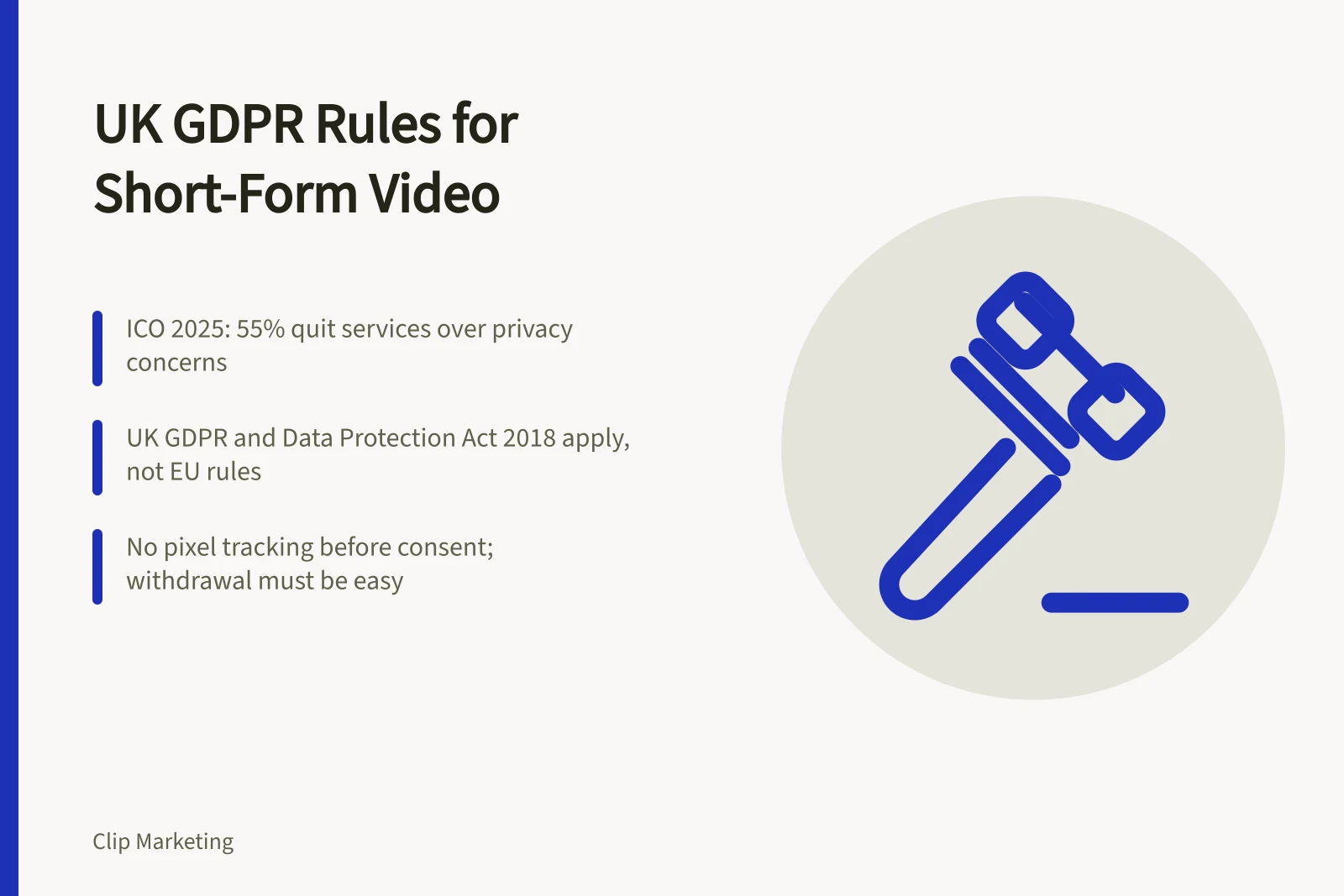
- The ICO's research published in 2025 found 55% of people had stopped using a website or service because of privacy concerns. Sloppy consent is a commercial risk, not just a legal one.
- Short form video data protection in England means UK GDPR and the Data Protection Act 2018, enforced by the ICO, not the EU rules many teams trained on.
- Consent for tracking pixels, lead forms and remarketing must be specific, informed and freely given, and you must make it as easy to withdraw as to give.
- Children's data needs extra carethe ICO's children's code applies to services likely to be accessed by under-18s, and the ASA's rules on advertising to children add a second layer.
- Keep a written record of your lawful basis, retention period and consent evidence for every campaign.
Does UK GDPR apply to your short form video content?
Yes, if your brand operates in England and processes personal data through video platforms. That includes view counts linked to logged-in accounts, comment moderation, lead capture forms and pixel-based retargeting.
The lawful basis matters. Consent suits retargeting and newsletter sign-ups. Legitimate interests may cover fraud prevention or basic analytics, but you must document the balancing test.
If your team runs campaigns across the UK, the wider short form video UK rules and compliance guide for 2027 covers the ground before you brief an agency. Advertising, data and platform terms all apply at once.
How should you collect consent for vertical video ads?
Consent must be an active choice. Pre-ticked boxes, silence and implied agreement from a continuing scroll do not count under UK GDPR.
Valid consent capture flow
- Active opt-in, no pre-ticked boxes
- Name purposes, platform, third parties
- No pixel fires before consent
- Offer simple withdrawal route
- Honour access, erasure, objection, portability
Your capture flow should name the purposes, the platform and any third parties. A pixel that fires before consent is a breach, even if the ad appears later.
Withdrawal has to be simple. The ICO's guidance on data subject rights sets out access, erasure, objection and portability, and viewers can exercise those rights against your marketing database, not just your website.
What are the extra duties when children watch?
The ICO's age-appropriate design code applies to online services likely to be accessed by children. That covers many short-form video platforms and the brand channels on them.
You should avoid profiling children for marketing, turn off behavioural advertising to under-18 audiences and use neutral age gates rather than self-declared birthdays alone.
The ASA's guidance on children and vulnerable audiences adds advertising-specific rules, including restrictions on targeting children with certain product categories.
Where does Ofcom fit into video marketing?
The Communications Act 2003 gives Ofcom its statutory footing for regulating broadcast and video-on-demand content, which matters if your brand moves into a regulated on-demand service.
Social media clips are generally outside Ofcom's remit, but paid video-on-demand can fall inside it. The dividing line depends on the service, not the screen size.
Check the Communications Act 2003 when you plan a branded streaming channel, because the duties differ sharply from a TikTok or Reels campaign.
What should a data protection checklist cover?
Enforcement sits mainly with UK-wide regulators, so the England-specific reading is set out in short form video UK regulations in England. A practical checklist covers:
Data protection checklist
- Record the lawful basis for each processing activity in your campaign plan.
- Document consent capture, including timestamps, wording and platform.
- Confirm age assurance for services likely to attract under-18s.
- List every third-party pixel, SDK and analytics tool with its data flow.
- Set retention periods for lead data and comment moderation records.
- Test the withdrawal route as a viewer, not as an admin.
- Brief creators and agencies on data handling before filming starts.
- Review platform terms alongside your own privacy notice each quarter.
Common questions
Does UK GDPR apply to short form video analytics?
Yes, where the analytics link to an identifiable person. Aggregated platform dashboards usually sit outside it, but logged-in view data and pixel events do not.
Can we retarget viewers who watched our video?
Only with a valid lawful basis. Consent is the safest route for advertising pixels, and legitimate interests needs a documented expectation and a clear opt-out.
Who enforces short form video data protection in England?
The Information Commissioner's Office enforces UK GDPR and the Data Protection Act 2018. Ofcom handles broadcast and video-on-demand standards, and the ASA covers advertising content.
Do we need parental consent for teen audiences?
Not always, but the children's code expects age assurance and privacy-by-default settings for under-18s. If consent is your basis and the child is under 13, parental consent is normally required. Individual cases need a qualified adviser.