Rules and ethics
Check UK ad disclosure and consent before approving short form video
Short form video rules and ethics for UK marketing teams: ad disclosure, data protection, consumer law and claim evidence, with a worked example.
What to take away
- Most teams approve the creative before they have checked the ad disclosure, the consent basis for any user data and the evidence for every claim. That is the mistake to fix first.
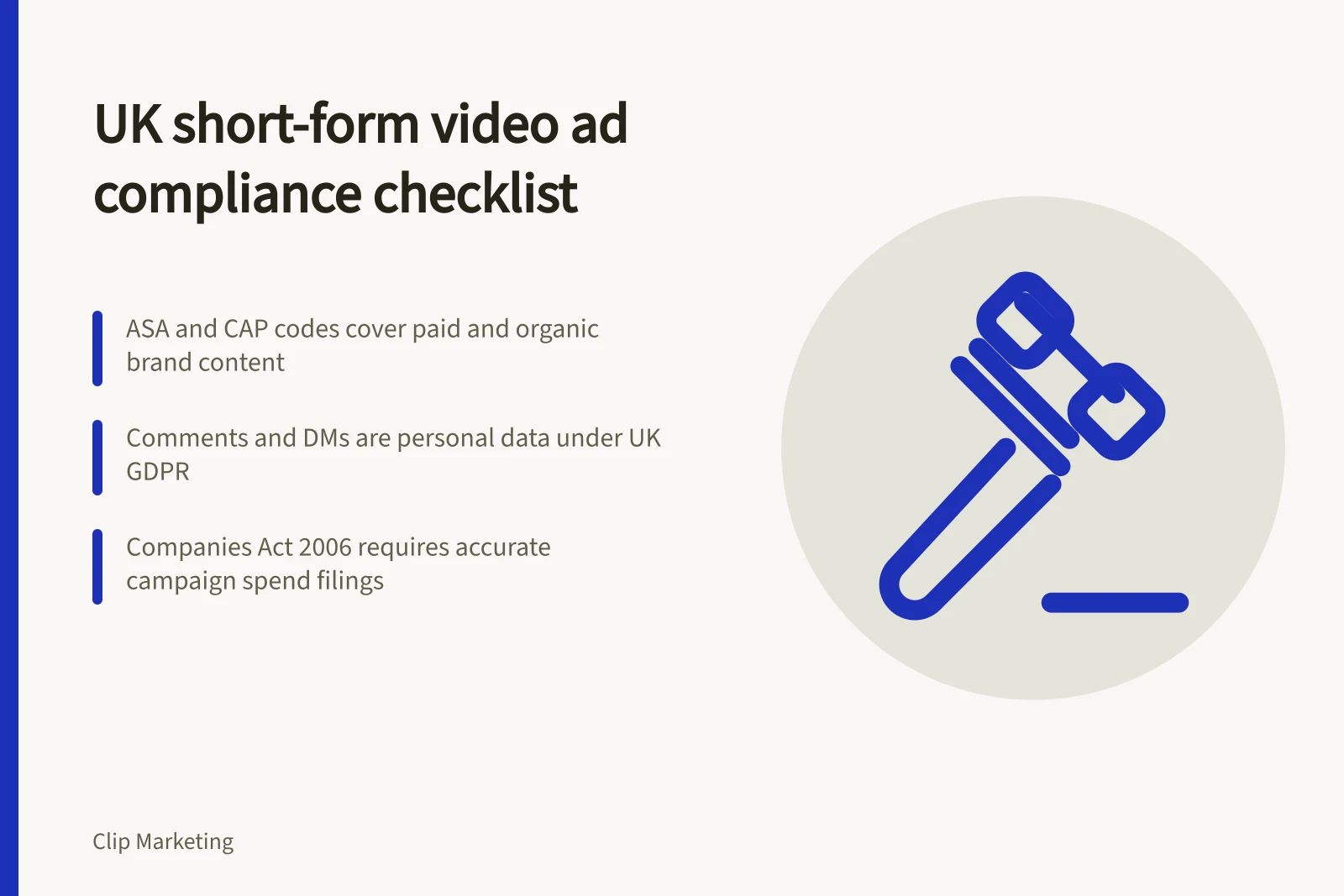
- In England, the Advertising Standards Authority (ASA) and the Committee of Advertising Practice (CAP) write the codes that cover paid and organic brand content on short form platforms. The ASA can refer persistent breaches to other regulators.
- If you handle personal data from comments, direct messages or lead forms, you are a controller under the UK GDPR and the Data Protection Act 2018. The ICO enforces that regime.
- Consumer protection law sits behind the codes. The Competition and Markets Authority (CMA) can act against misleading commercial practices, and consumers can seek redress.
- Keep a written record of your decisions, approvals and evidence. The Companies Act 2006 sets the framework for company reporting, and marketing agencies are not exempt from it.
Where the rules come from
The advertising codes and the ASA
Short form video marketing in England is not governed by one statute. It is governed by a mix of advertising codes, data protection law, consumer law and platform terms.
Is Your Video an Ad?
Does the brand pay for placement?
Likely an ad under ASA rules
Check editorial control next
The codes are written by the Committee of Advertising Practice and administered by the Advertising Standards Authority. The ASA's own explanation of how UK advertising regulation works sets out that the system is self-regulatory and funded by a levy on advertisers. It also confirms that the ASA can refer non-compliant advertisers to trading standards or to other regulators.
That matters because a video that looks like a casual post can still be an ad in the ASA's eyes. The practical test is whether the brand has editorial control or pays for the placement. If either is true, the content is likely to be an ad.
The CAP code has separate sections for recognition of marketing communications, misleading advertising and comparative claims. A vertical video that mixes product demonstration with entertainment still has to satisfy all three.
For a fuller treatment of how paid placements are classified, see short form video advertising rules in England, which walks through the recognition tests the ASA uses. The codes apply across the UK, but enforcement priorities and trading standards arrangements differ in Scotland, Wales and Northern Ireland, so check locally if you run activity outside England.
Consumer law and the CMA
Advertising codes sit on top of consumer protection law. The Consumer Protection from Unfair Trading Regulations 2008 prohibit misleading actions and omissions in commercial practices. The Digital Markets, Competition and Consumers Act 2024 updated the CMA's powers.
GOV.UK's help for consumers page explains that consumers have rights in relation to misleading advertising and can complain to the relevant body. A short form video that hides a material fact, such as a monthly fee or a delivery charge, can be a misleading omission even if every individual frame is accurate.
The CMA can act against misleading commercial practices and, in serious cases, seek redress for consumers. For marketing teams, the operational point is that the caption, the on-screen text and the spoken script are all part of the same claim. If the caption says "free" and the video says "free trial", the caption is the problem.
Price claims carry extra weight. A discount calculated against a price the product never sold at is likely to mislead. Keep the original price list and the dates it applied, because both the ASA and the CMA can ask to see it.
Data, disclosure and evidence
Consent, comments and lead forms
Short form platforms generate personal data constantly. A comment, a direct message, a poll response or a lead form is personal data if it can identify a person.
Consent and Disclosure Checklist
- Identify lawful basis for processing personal data
- Publish privacy notice naming the platform
- Make ad disclosure clear before viewer engages
- Avoid labels buried under 'more' links
- Do not treat platform analytics as anonymous
The ICO publishes UK GDPR guidance and resources that set out the lawful bases for processing, the right of access and the rules on international transfers. If you are running a competition or collecting emails through a video campaign, you need a lawful basis and a privacy notice that names the platform.
One common failure is treating platform analytics as anonymous. Aggregated dashboards can still contain personal data if the audience is small or the identifiers are re-linkable.
For a focused look at how this plays out in practice, read short form video data protection in England, which covers retention periods and subject access requests. The same rules apply in Scotland, Wales and Northern Ireland, because the UK GDPR is UK-wide, but the ICO's regional engagement differs.
Disclosure that survives a caption
Disclosure has to be clear before the viewer engages. A label buried under a "more" link or shown for half a second is not clear. The CAP code requires that ads are obviously identifiable, and the ASA has repeatedly ruled against influencers who used ambiguous labels such as "collab" or "sp" without explaining them.
The safest approach is a verbal disclosure in the first few seconds, an on-screen label for the duration of the paid segment, and a platform disclosure tool where one exists.
Music and footage carry their own rights. A track from a personal playlist is not licensed for a brand video, and platform audio libraries set their own commercial terms. Clear both before the edit is locked.
Disclosure covers more than influencers. If an employee posts about a product they work on, the employment relationship can be a material connection.
For a detailed policy template, see short form video disclosure policy in England, which sets out wording that matches what the ASA expects. The rules are UK-wide, but the ASA's case handling is administered from London and applies across England, Scotland, Wales and Northern Ireland.
Evidence for every claim
Every factual claim in a short form video needs evidence before it is published. That includes price comparisons, health claims, environmental claims and performance statistics. The CAP code requires that claims are substantiated, and the ASA can ask for evidence after a campaign ends. If you cannot produce the evidence, the claim should not run.
Keep a claim file with the source, the date and the person who approved it.
Testimonials and reviews need the same treatment. A review quoted on screen should be genuine, current and used with permission, and any incentive offered for it should be disclosed. One enthusiastic customer is not evidence for a claim about a whole product range.
For a worked example, imagine a team paying £400 a month for a creator programme. If one video claims "saves you 40% on energy", the team needs a dated source for that figure.
A supplier's marketing deck is not enough. The team should either commission a verifiable test or change the claim to something they can prove, such as "our customers report lower bills", with the caveat shown on screen.
Reporting, records and the worked example
Company reporting and agency records
The Companies Act 2006 is the statutory framework for company reporting and disclosure. Marketing agencies and brands that are limited companies must file accounts and confirmation statements, and the directors are responsible for the accuracy of those filings.
Records to Keep for Compliance
- Creator brief you sent
- Approved script
- Disclosure wording used
- Date the video went live
- Related party transaction notes
That matters for marketing because campaign spend, creator payments and platform fees all flow into the accounts. If a campaign is funded by a client and the agency pays the creators, the agency may be acting as principal, which affects both the accounting and the VAT treatment.
Directors should also consider whether a campaign creates a disclosable related party transaction. If a director's family member is paid as a creator, that is a related party matter. These are general points, not tax advice, and individual cases need a qualified adviser.
Records are also the practical defence in a complaint. Keep the brief you sent to the creator, the approved script, the disclosure wording and the date the video went live. If the ASA or the CMA asks, you can show what you approved.
For the wider regulatory picture, including platform duties, see short form video UK regulations in England, which maps the Online Safety Act 2023 duties onto short form content.
A worked example with labelled figures
Suppose, as an illustrative example, a Manchester-based skincare brand runs a six-week short form campaign in England. The budget is £12,000. Creator fees are £6,000, paid to three creators. Paid amplification is £4,000. Production is £2,000. The campaign collects 1,800 email addresses through a lead form and 400 comments containing personal data.
The compliance work should include the following. A written disclosure instruction to each creator, signed before filming. A privacy notice covering the lead form, the platform and the retention period. A claim file for the two product claims, each with a dated source. A record of the ASA code version applied.
Then a note in the accounts showing creator payments as marketing spend, with the related party position considered if any creator is connected to a director.
Budget the compliance time as well. Allow, for example, £1,500 of the £12,000 for legal review, creator contracts and privacy drafting. That is 12.5% of the campaign budget. Teams that skip it often spend more later on takedowns, refunds and revised creative.
If a brand skips the disclosure instruction and a creator posts unlabelled, the ASA can investigate. If the brand cannot show a lawful basis for the lead form, the ICO can act. If the claim file is empty, the brand may have to withdraw the claim and refund affected customers.
The cost of fixing this after publication is usually higher than the cost of compliance work before filming.
The EU dimension
If the campaign targets viewers in the EU, platform rules and advertising rules change. The European Commission's online platforms policy page explains the EU approach to platform accountability, including advertising transparency rules.
A campaign running in England and Ireland may need two disclosure regimes. The simplest approach is to apply the stricter standard across both, usually a clear verbal and on-screen label in the first three seconds.
Northern Ireland sits in a different position, because some EU rules continue to apply there. If your audience crosses the border, treat the disclosure question and the data transfer question separately.
For the next buying cycle, short form video trends and outlook for England in 2027 covers the format shifts likely to affect compliance work: longer vertical edits and shoppable overlays.
The rules do not change with the format, but disclosure must adapt. A label that works on a 15-second clip may fail on a three-minute vertical video, since viewers can join halfway through.
Common questions
Does the ASA cover organic short form video?
Yes, if the content is an ad. The ASA's remit covers paid and organic content where the brand has control or pays for placement. A purely organic post by a customer with no brand involvement is outside the remit, but the line is often unclear. If in doubt, disclose.
Do I need consent to use comments in a video?
Usually yes, if the comment identifies a person and you are using it in marketing. Comments are personal data under the UK GDPR. You need a lawful basis, and consent is the most straightforward one for reposting. Keep a record of the consent and the date.
Who enforces the rules if a creator breaks them?
The ASA enforces the advertising codes and can name the advertiser and the creator. The CMA can act on misleading commercial practices. The ICO can act on data protection breaches. In practice, the brand is usually the first point of contact, so the contract with the creator should require compliance and allow the brand to take down non-compliant content.
Is this legal advice?
No. This is general guidance for marketing teams in England, with notes where the rules are UK-wide. Individual cases depend on the facts, and you should take advice from a qualified solicitor or compliance adviser before publishing a campaign that carries legal risk.
In this guide
- What short form video UK regulations mean for marketing teamsA plain guide to short form video UK regulations for teams in England, covering advertising rules, consent for electronic marketing and when to take legal advice.
- Short form video advertising rules without the guessworkAn England checklist for short form video advertising rules: ASA claims and disclosure, ICO direct marketing consent, and the Data (Use and Access) Act 2025.
- Why short form video data protection matters for England's marketing teamsHow UK GDPR, ICO guidance and children's privacy rules shape short form video data protection in England, plus a practical compliance checklist.
- Seven clauses to check in short form video commercial contractsSeven clauses in short form video commercial contracts that decide who owns the footage, who can reuse it and who pays when a platform pulls a post.
- Short form video disclosure policy explained for EnglandA practical how-to for English marketing teams on building a short form video disclosure policy, covering advertising rules, consumer law and programmatic buying.