Operations
Part of What stronger short form video operations mean for UK marketing teams
A short form video launch review you can run, or a vendor's showreel?
A runnable short form video launch review with a step-by-step checklist and questions to ask before signing, plus real tools for verifying vendor claims.
What to take away
- A launch review checks process, evidence and ownership. It is not a vote on whether a vendor's clips look good.
- In Leeds, Manchester or London, ask which platform, which account, which date range and which baseline.
- The review covers submitted briefs, scripts, approvals, rights paperwork and reports. It does not test any tool, and no vendor saw our process.
- Claims stay claims until a third party can check them. Independent evidence means platform documentation or your own logged data.
- For the wider operating model, the short form video operations and delivery guide for 2027 shows how briefs, approvals and reporting fit together.
Run the review in eight steps
Eight-step launch review
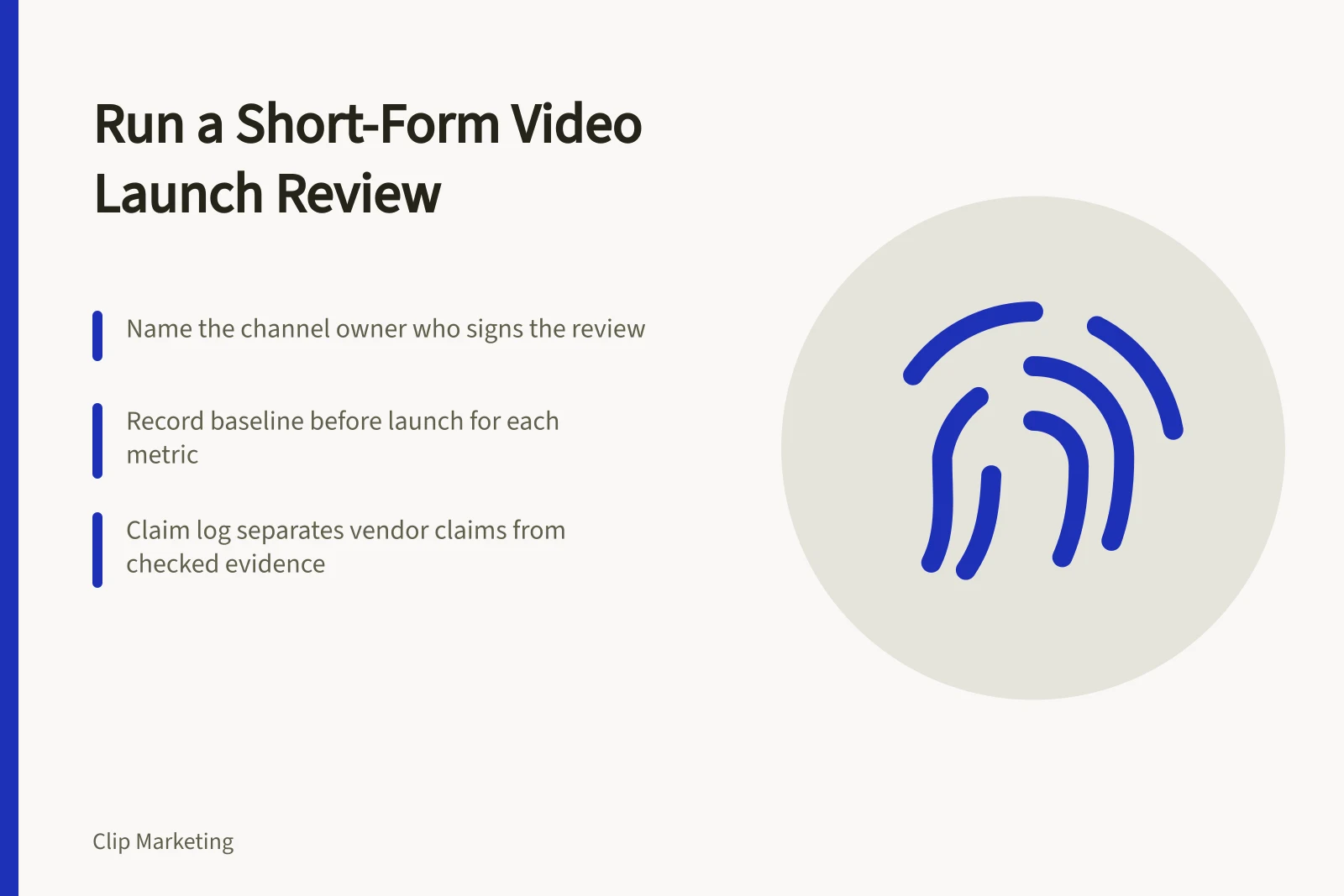
- Name the owner
- Set scope
- Build evidence folder
- Check rights per asset
- Verify claims in native tools
- Compare plan to platform limits
- Check consumer promises
- Name the owner. The person accountable for the channel signs the review, not the agency. The short form video team roles: data and sources article explains why unnamed ownership stalls launches.
- Set scope. List channels, campaigns, dates and assets. Write the metric before you look at results.
- Build an evidence folder. Store the brief, script, approval thread, schedule and reports in one place. Add the shot list if one exists.
- Check rights per asset. Record music, contributor releases and stock licences. If a supplier says rights are handled, ask for the file.
- Verify claims in native tools. Meta Ads Manager shows account-level campaign metrics. TikTok Ads Manager shows ad performance and creative data. YouTube Studio shows watch time and retention for owned channels. For citable documentation, Microsoft Advertising documentation describes official interfaces and reporting structures.
- Compare the plan to platform limits. LinkedIn Ads suits B2B formats such as sponsored content and lead forms. Its self-serve tools have targeting and budget controls.
- Check consumer promises. If you sell digital content or subscriptions, the Consumer Rights Act 2015 sets standards for digital content and services.
- Write gaps with owners and dates. Recheck at the next launch, not six months later.
Pre-signing checklist
Pre-signing checklist
- Owner named for calendar and numbers
- Brief includes audience and deadline
- Script and shot list match brief
- Approval thread shows who said yes
- Rights file lists every licence
- Baseline recorded before launch
- Claim log separates claims from evidence
- Owner named for calendar, asset library and weekly numbers.
- Brief includes audience, message, format and deadline.
- Script and shot list match the approved brief.
- Approval thread shows who said yes and when.
- Rights file lists every music track, contributor and stock licence.
- Baseline recorded before launch for each metric.
- Reporting names platform, account, date window and metric owner.
- Claim log separates vendor claims from checked evidence.
- Access plan covers read-only ad accounts or exported reports.
- Exit terms cover assets, accounts and data.
Questions to ask before signing
- Which platform and account will host the work? Ask for TikTok Ads Manager, Meta Ads Manager, LinkedIn Ads or YouTube Studio access.
- What is the baseline? For example, YouTube Studio average view duration for the last 90 days.
- Which reporting tool will you use? Hootsuite sells tiered subscriptions for publishing and analytics. Sprout Social sells subscription plans for publishing, listening and reporting. Brandwatch is enterprise social listening sold by quote.
- How will you label claims? Ask for screenshots with account name, date range and metric definition.
- Who owns the rights file? Ask for every licence and release before the first publish.
- What happens if a platform changes its rules? Name the owner who checks platform documentation.
- How will you store approvals? Notion has a free personal plan and paid team plans. Airtable has a free plan and paid team plans.
- Which review tool will you use? Frame.io offers paid review and approval tiers. Buffer and Later offer paid scheduling plans for social channels.
- What is the rollback plan? Include who can pause spend, hide posts or pull assets.
- What are the exit terms? Cover account ownership, asset handover, data export and deletion.
Glossary
- Briefthe written instruction covering audience, message, format and deadline.
- Baselinethe pre-launch figure a result is compared against.
- Claima statement by a vendor or agency about its own work.
- Evidencea record that a third party can inspect.
- Launch reviewa documented assessment of process, evidence and ownership.
- Rights filethe record of licences and releases for each asset.
Common questions
How long should a launch review take?
For one campaign, allow a working day to read the brief, approvals, rights file and reports. A multi-channel programme needs longer. Repeat the review at each launch.
Can it be done without ad account access?
Yes, but it is weaker. You can assess briefs, scripts and rights records. Performance claims cannot be verified from a deck, so mark them unverified.
Who signs off?
The channel owner signs, not the agency. In most English teams that is the marketing lead or head of content. Add finance or legal for significant spend.
What if the review finds gaps?
List each gap with an owner and date. A missing rights record is more serious than a weak hook because it carries legal and platform risk.