Tools and providers
Part of How to choose short form video tools and providers for a marketing team
Short form video software selection without the wrong turn
A practical guide to short form video software selection for English marketing teams, covering requirements, procurement, contracts and a worked budget example.
What to take away
- A Bristol team of six publishing vertical video to two platforms may need one licence, if it covers editing, scheduling and reporting.
- Score vendors on delivery, rights and data terms, not the demo reel.
- Budget for the whole stackediting, scheduling, asset storage and reporting.
- Check the contract against consumer and competition law before signing anything multi-year.
- Pilot with one campaign and one owner, then scale.
Match the tool to the channel you will run
A Yorkshire retailer planning TikTok and Reels needs different software from a Leeds consultancy posting vertical video on LinkedIn. List the platforms you will publish to next quarter, then check which formats each tool exports natively.
Match tool to channel
- List platforms for next quarter
- Check native export formats
- Review LinkedIn ad formats
- Check Microsoft Advertising docs
- Write one scoring sentence per platform
LinkedIn supports vertical video in its feed, and its advertising guidance sets out the formats and targeting available. If LinkedIn is your main channel, review the LinkedIn video advertising formats before shortlisting editors and schedulers.
For paid distribution beyond social platforms, Microsoft Advertising documents its video ad options in its developer documentation. Read the Microsoft Advertising developer documentation so the tool you pick can push assets and reporting data correctly.
Write one sentence per platform describing the job the software must do. That sentence becomes your scoring line.
Requirements that survive procurement
Most short form video software selection exercises fail because the requirements list describes features rather than work. Build yours from tasks your team already performs.
Requirements that survive procurement
- Capture and editing
- Scheduling and publishing
- Asset storage and rights
- Reporting
- Fifth area only with named owner
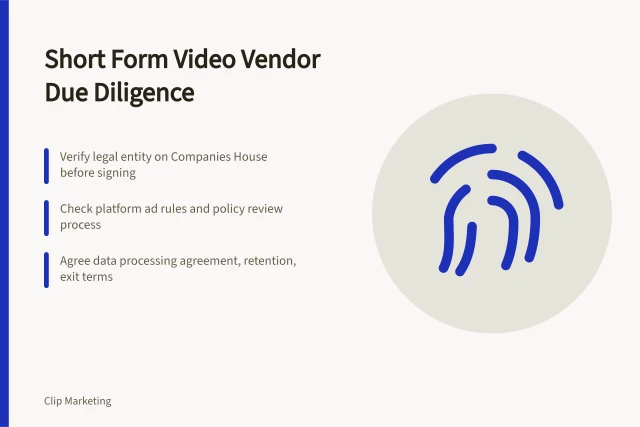
Ask each vendor three questions. Where is the data stored? Who owns the exported files? What happens to your assets if you cancel?
Those answers matter more than timeline animations. They also feed the implementation plan, where rollouts stall. Our guide to short form video tool implementation in England covers the handover steps between signing and first publish.
Score vendors on evidence, not demos
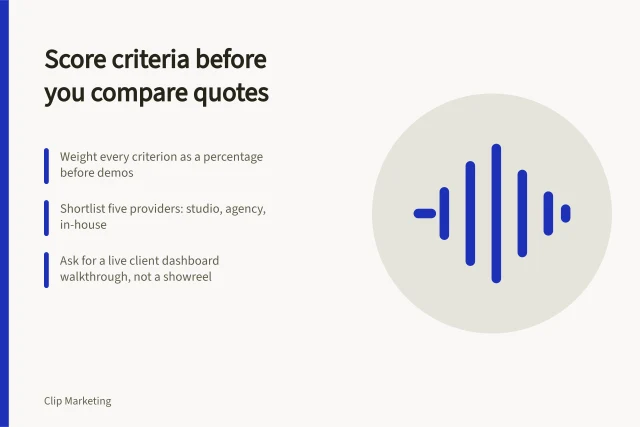
Give every shortlisted tool the same test: one vertical video, one caption set, one scheduled post and one report export. Run it with the person who will use it daily.
Score each vendor out of five on setup time, export quality, reporting clarity, support response and contract flexibility, weighted to your channel mix.
A tool that scores well on editing but cannot export a clean report costs hours every month. A tool that scores well on reporting but forces manual caption entry costs accuracy.
Keep the scoring sheet. It is the evidence you need when someone asks why the cheaper option was rejected.
A worked example for a small English team
A six-person marketing team in Bristol runs vertical video on two platforms with £450 a month for software: £200 for editing, £150 for scheduling and £100 for reporting. That is £5,400 a year, an illustrative figure.
They shortlist three vendors. Vendor A wins on editing but needs separate reporting at £90 a month. Vendor B covers scheduling and reporting but exports weaker files. Vendor C covers all three at £420 a month, leaving £30 for storage.
They choose Vendor C and review after one quarter. Committed spend is £5,040 a year, again illustrative.
Contracts, rights and the rules that apply
Marketing software contracts often bundle data processing, content licensing and advertising services, which brings consumer protection and competition law into scope.
The Competition and Markets Authority enforces consumer protection and competition law relevant to advertising and marketing practices, and its guidance is a sensible check before a multi-year deal.
Watch three clauses: auto-renewal notice periods, data portability on exit, and rights to use exported video in paid campaigns. A vendor who cannot answer clearly fails the score.
Build a selection process you can repeat
Selection is not a one-off purchase. Platforms change formats, teams change channels and licences renew, so write the process down.
Review your stack every six months against the channel list. Retire tools with no named owner. Renegotiate before renewal, not after.
The wider supplier picture, including pricing models and provider types, sits in our short form video tools and supplier guide for 2027. Use it alongside this process when you next go to market.
Common questions
How long should a software pilot run?
One campaign cycle is enough. For most English teams that means four to six weeks, covering brief, edit, publish and report.
Should we buy one tool or several?
Buy one if it covers editing, scheduling and reporting to your standard. Buy several only when each has a named owner.
What should we check before auto-renewal?
Check usage against licence count, export quality, support response times and the notice period. Diarise the notice date 60 days ahead.
Do we need legal review for a small licence?
Use your normal approval threshold. Anything with auto-renewal, data processing or content rights deserves a documented review.