Tools and providers
Part of How to choose short form video tools and providers for a marketing team
3 steps to a short form video tool rollout that sticks
Score candidates, pilot one tool, and set the reporting you will keep. A step-by-step plan for short form video tool implementation in a UK team.
What to take away
- Start from the decision you are actually makingwhich one tool your team will run for the next two quarters.
- Score three to five candidates against your own workflow, not a vendor feature list.
- Pilot with real footage for two weeks, then compare output per hour, not output per pound.
- Agree the monthly reporting set before you sign.
- Hold an exit routemonthly billing or a break clause.
Define the workflow before you compare tools
Short form video tool implementation starts with a map, not a shortlist. Trace one clip from card offload to published post. Note every handover, because handovers are where software either saves time or adds a step.
Clip workflow map
- Card offload
- Handover
- Edit
- Caption
- Approval
- Publish
Count the steps as well. A five-step process carrying three manual uploads has a different problem from a two-step process with one slow render.
If you are starting from nothing, the short form video tools and supplier guide for 2027 sets out the tool categories you will meet and what each one is for.
Write down the job the tool must do
A tool earns its seat by owning a step. Editing, captioning, scheduling and approval can sit in one product or in four. Decide which steps you will consolidate and which you will leave alone.
The answer depends on team size. A single editor publishing twice a week rarely needs the approval chains an agency does.
Then check the destinations you publish to. The LinkedIn Ads guide lists the formats available and the creative each placement needs, which sets the export sizes your process must produce.
Set pass or fail tests
Write tests a candidate either passes or fails. Vertical video exported at 1080 by 1920. Burned-in captions you can edit later. Two-step approval before publishing. A named owner for every project.
Keep the list short. Ten tests nobody remembers are worse than four the team applies every time. A tool that fails one test leaves the shortlist, however good the demo looked.
Score candidates on the same rubric
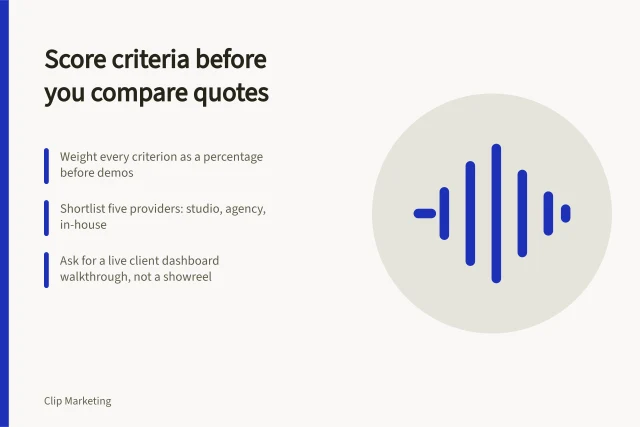
Use one scoring sheet for every candidate. The weights below are an illustrative example for a four-person team, not a benchmark.
Candidate scoring rubric
Criterion
- Publishing reliability
- On time, failures flagged
- Time per finished clip
- Under 40 minutes
- Reporting depth
- Views, watch time, followers
- Access control
- Editor, reviewer, client roles
- Exit terms
- Monthly or under 60 days
What good looks like
- Publishing reliability
- 25%
- Time per finished clip
- 20%
- Reporting depth
- 20%
- Access control
- 20%
- Exit terms
- 15%
Weight
- Publishing reliability
- Time per finished clip
- Reporting depth
- Access control
- Exit terms
Score each candidate twice: in a demo, then after a week of real work. If two candidates tie, the tie-breaker is the tool your editors open without being asked.
Weight the criteria to your team
A solo operator should weight speed above access control, while an agency serving clients should do the reverse. Work through the short form video software selection in England checklist, then re-run the scores rather than arguing from memory.
Run a two-week pilot
Give one editor a real brief with a real deadline. Count finished clips, revision rounds and publishing failures. Compare that against the tool you use now.
Use the content you publish most often, not a showpiece project with extra time set aside.
If nobody in the team owns procurement, the IAB UK SME toolkit gathers free practical resources for small businesses running digital campaigns.
Roll out without stalling production
A rollout stalls when the team has two places to look. Short form video tool implementation is a production project before it is a software purchase. Move one workflow at a time and keep the old route open until the new one holds.
Set permissions and naming on day one
Agree folder names, project names and who can publish before the first clip lands. Write the naming rule as one line and pin it in the team channel. Renaming 200 clips later is the job nobody volunteers for.
Review at 30 and 90 days
At 30 days check adoption: seats in use, clips published, minutes per clip; at 90 days check the commercial case and the renewal date.
Bring the invoice, seat count and clip count to the same meeting. Google's guide to YouTube Analytics sets out the metrics the platform reports, keeping the review on data you can pull, not screenshots.
Common questions
How long does implementation take?
Two weeks of pilot plus one week of setup is enough for most small teams. The variable is old footage, not the software.
Do we need to change tools at all?
No, if your current setup passes the rubric and the team uses it. Switching carries a cost that a price list never shows.
What should the pilot measure?
Finished clips, minutes per clip and publishing failures. Add revision rounds if someone outside the team reviews work before it goes live.
When should we review the decision?
At the renewal date, and sooner if the team grows or a platform changes its format rules. Tie the review to a date rather than a feeling.