Strategy
Part of What should a short form video strategy for 2027 include?
Build a short form video strategy framework you can actually run
A step-by-step short form video strategy framework: set the objective, format rules, channel roles, measurement and review cycle before briefing.
What to take away
- Decide which single business outcome the framework must serve before you pick formats, because the objective sets the metrics and the budget.
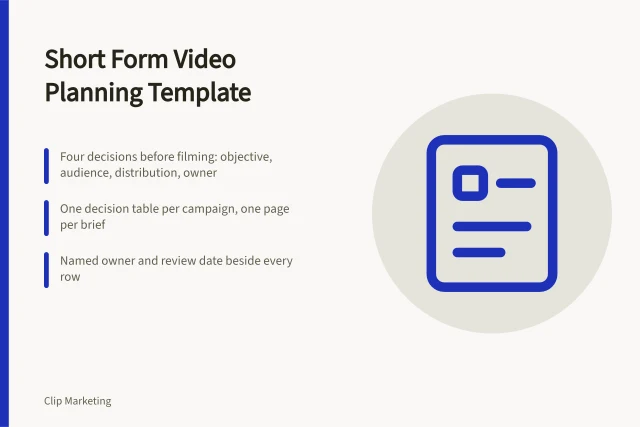
- Work from a written one-page frameworkobjective, audience, format rules, channel roles and measurement, agreed before filming starts.
- Treat mobile viewing as the default. Test how your landing pages behave on a phone before you drive video traffic to them, using Google's guidance on optimising your website for mobile.
- Set a review rhythm so the framework is amended by evidence, not opinion.
Start with the decision, not the format
A short form video strategy framework exists to stop the same argument recurring. The first decision is what the video is for: awareness, consideration, conversion or retention. Each implies different lengths, calls to action and success measures.
Objective sets the video rules
Awareness
- Length
- short
- Call to action
- watch more
- Success measure
- reach
Consideration
- Length
- medium
- Call to action
- compare
- Success measure
- engagement
Conversion
- Length
- direct
- Call to action
- enquire
- Success measure
- enquiries
Retention
- Length
- recurring
- Call to action
- stay subscribed
- Success measure
- repeat views
Write the objective as one sentence with a number and a date. For example, a team might commit to 40 qualified enquiries from vertical video by 31 March. That figure is illustrative, not a benchmark.
Once the objective is fixed, everything else becomes a choice rather than a debate. The wider planning context, including how the framework sits alongside budget and channel choices, is set out in the strategy and planning guide for 2027.
Define the audience and the job to be done
Describe the viewer in operational terms: where they spend attention, what they are trying to solve, and what they do instead. A framework that describes the audience only as 18 to 34 tells a production team almost nothing useful.
Audience paired with job
Never heard of you
- Attention
- scrolling
- Problem
- unaware
- Alternative
- doing nothing
- Evidence
- intro
Comparing two suppliers
- Attention
- researching
- Problem
- choosing
- Alternative
- competitor
- Evidence
- proof
Pair each audience with one job to be done. A viewer comparing two suppliers needs different evidence from a viewer who has never heard of you, so record both side by side.
Set format rules before production
Format rules keep output consistent when several people are filming. Agree safe areas for captions, minimum text sizes, aspect ratios, opening seconds and the permitted calls to action.
Treat vertical video as the default, with square and horizontal crops as exceptions you justify.
Record who signs off a script and how quickly. Slow approval stalls more plans than budget does, so name an approver in advance.
Choose channel roles deliberately
Give each platform one job. One channel may exist to reach new viewers, another to answer objections, and a third to convert warm audiences.
If you are testing paid video, the setup steps for campaigns, targeting and creative formats are covered in LinkedIn's guide to getting started with advertising.
Set a minimum test size so a weak result is not dismissed as insufficient spend. Two weeks and a defined spend figure is a workable starting rule.
Decide the production model
Choose between in-house filming, a freelance editor, an agency retainer or a creator partnership. The choice follows from volume and turnaround time, not preference.
A practical model pairs one person accountable for the calendar with one person accountable for quality. Volume targets without an owner are intentions rather than plans.
Keep a small library of reusable assets: opening sequences, lower thirds, caption styles and music cleared for commercial use.
Build measurement into the framework
Pick one primary metric per objective and no more than three supporting metrics. Views alone rarely justify continued investment, so connect video activity to a downstream action such as a form completion or a booked call.
Track monthly at minimum and note what changed each time. Marketing guidance from the Chartered Institute of Marketing's content hub is a sensible reference for aligning content plans with commercial objectives.
Put the framework on a calendar
Translate the framework into a dated schedule with owners. A structured rollout reduces the risk of a strong plan quietly stopping after six weeks. The ninety day plan for England shows how to sequence it week by week.
Glossary
- Framework
- the written set of decisions that governs video output.
- Vertical video
- footage shot for portrait screens, typically 9:16.
- Safe area
- the region of the frame that stays visible when captions appear.
- Primary metric
- the single number that decides whether the objective was met.
- Test size
- the minimum spend and duration agreed before judging a channel.
Common questions
How long should a short form video strategy framework be?
One page for the decisions and one page for the calendar is usually enough. Length is not the constraint; agreement is.
Who should own the framework?
A named marketing lead should own it, with a production contact responsible for delivery.
How often should the framework be reviewed?
Review at a fixed interval, such as every ninety days, and amend it only when the evidence supports a change. Ad hoc rewrites undermine comparison.
Does the framework need to differ across the UK?
Broadly no, because advertising and consumer rules apply across the UK. Where a rule is devolved, check the position for Scotland, Wales or Northern Ireland.