Audience research
Audience data or audience guesswork, the short form video audience research guide
A practical guide to short form video audience research for England, covering ONS data, interviews, competitor gaps, personas and measuring results.
What to take away
- A marketing lead at a Manchester ecommerce brand can watch six customers use their own phone and learn more in an afternoon than from a month of dashboard watching. Audience research starts with people, not platforms.
- Public data sets the frame before you spend. National statistics show how many adults use the channels you plan to buy, and how often, before a single pound goes out.
- Interviews and competitor research explain why people watch, scroll past or buy. A retention chart shows the drop at second three; it cannot tell you the reason for it.
- Personas turn raw notes into briefs a producer or media buyer can act on. Without them, every edit decision becomes an argument.
- Measure after you publish, then feed the numbers back into the persona pages. Research that never meets a result is a hobby.
Why audience research comes first
Most short form video plans start with a format. Someone has seen a talking-head clip work for a competitor and wants the same thing by Friday. The format is the easy part. Knowing who should watch it, and why they would stop scrolling, is the work.
Audience research is the step that decides what you make, how long it runs, which platform carries it and what you say in the first two seconds. Get it wrong and you produce polished video for people who were never going to buy.
This guide covers methods that fit a UK marketing team with limited time and no dedicated research budget. It focuses on England because that is where most of our readers' customers sit, but the published sources we cite cover national populations rather than one region.
Skipping this step rarely produces an obvious failure. The videos still go out. They simply underperform, and nobody can say why, so the team blames the algorithm and repeats the same format next quarter.
Start with published data
The fastest research is already done. The Office for National Statistics publishes regular figures on home internet and social media usage that break down who is online and which services they use. Check them before you build a plan on instinct.
If your hunch is that everyone under 30 is on one app and nobody over 50 is, the data will either support that or correct it. Either outcome saves money, and both are cheaper than a campaign built on a guess.
Industry bodies add channel-level detail. The Data & Marketing Association, a UK trade body, publishes research on consumer behaviour and channels that helps place video within a wider media mix. That matters when a finance director asks why video deserves budget over email.
Regulatory research is useful too. The Advertising Standards Authority and the Committee of Advertising Practice, the UK advertising regulators, publish research on advertising issues covering how audiences react to claims, disclosures and ad formats. If your video makes a health, finance or environmental claim, read that before you film it.
Every published figure arrives with a sample and a fieldwork date. Write both down. A finding drawn from a large panel two years ago carries different weight from a smaller study run last month.
Desk research in an afternoon
Set aside three hours. Open a spreadsheet with four columns: source, finding, date, confidence. Keep it to twenty rows. Six figures you trust beat forty you half remember.
Three-hour desk research plan
- Spreadsheetsource, finding, date, confidence
- Keep to twenty rows maximum
- Check ONS statistical release first
- Then industry library for your sector
- Then regulatory research if ads make claims
- Record the date of every figure
- Write three sentencesaudience, behaviour, unknowns
Work through the statistical release first and note the figures that touch your category. Then check the industry library for anything on your sector. Finally, look at the regulatory research if your ads make claims.
Record the date of every figure. A statistic from 2019 about platform use is a historical document, not a planning input. When you brief a colleague, quote the year alongside the number.
Write down where each figure came from and how it was collected. A survey of 2,000 adults and an industry panel of 200 marketers answer different questions, even when the headline number looks similar.
Finish by writing three sentences: who you believe your audience is, what they currently do, and what you still do not know. That last sentence is your interview brief.
Talk to real customers
Nothing replaces a conversation. Recruit eight to twelve customers or near-customers who match your target. Offer a voucher, keep each session to 25 minutes, and record with permission.
Customer interview session rules
- Recruit eight to twelve matched customers
- Offer a voucher, keep sessions to 25 minutes
- Record only with permission
- Ask what they watched yesterday
- Watch them scroll their own feed
- Include two or three rival buyers
- Write one page of notes same day
- Tag notesmotivation, barrier, trigger, channel
Ask what they watched yesterday, not what they generally watch. Ask them to open the app and scroll while you watch. The gap between what people say they do and what their thumb does is where the useful findings live.
Our guide to running short form video customer interviews in England covers recruitment, question wording and how to avoid leading people towards the answers you want.
Recruit a mix. If every participant already buys from you, you will hear praise rather than friction. Include two or three people who chose a rival, and listen for the moment they decided.
After each session, write one page of notes the same day. Memory distorts within hours. Tag each note as motivation, barrier, trigger or channel.
Keep the recordings. A clip of someone scrolling their own feed, narrating what they skip, does more for an editing team than any written summary of the same session.
Competitor research without copying
Look at what your competitors publish, but study the comments rather than the view counts. Comments tell you what the audience wanted and did not get. That gap is your opening.
What to study in competitor videos
Study this
- Comments
- Audience gaps
- View counts
- One-off virals
- First three seconds
- Hook type
- Ad libraries
- Currently paid creatives
- Repetition
- Signals what works
Ignore this
- Comments
- Praise and noise
- View counts
- Repeat funding
- First three seconds
- Production polish
- Ad libraries
- Old campaigns
- Repetition
- Signals laziness
Track the first three seconds of ten competitor videos. Note the hook type: question, bold claim, visual surprise, direct address. Then note which hooks appear repeatedly. Repetition usually signals something works.
Paid activity is worth watching too. Most large platforms publish ad libraries showing which creatives a brand is currently paying to run. A format a competitor keeps funding is more telling than one that went viral once.
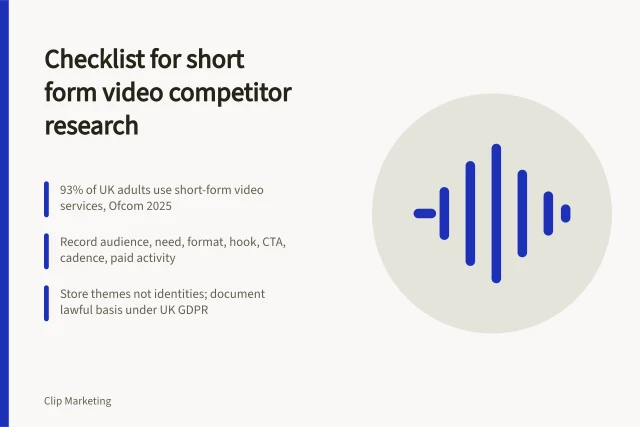
Our walkthrough of short form video competitor research in England explains how to log formats, posting frequency and response patterns in a single sheet.
Do not copy a competitor's format because it performed for them. Copy the discipline of testing hooks and reviewing results.
Build personas you will use
A persona is a working tool, not a poster. Keep it to one page: name, situation, goal, barrier, platform habit, and the trigger that makes them act.
One-page persona contents
- Name
- Situation
- Goal
- Barrier
- Platform habit
- Trigger that makes them act
- Built from interviews plus published data
- Two or three personas is plenty
Write personas from your interview notes and published data together. If your notes say customers are cost-conscious and the national figures show your age group is under financial pressure, the persona carries both.
Build them with the people who speak to customers. A sales team knows which objection comes up on every call, and that objection belongs on the persona page.
Two or three personas is plenty for a small team. A list of eight gets consulted once and then ignored.
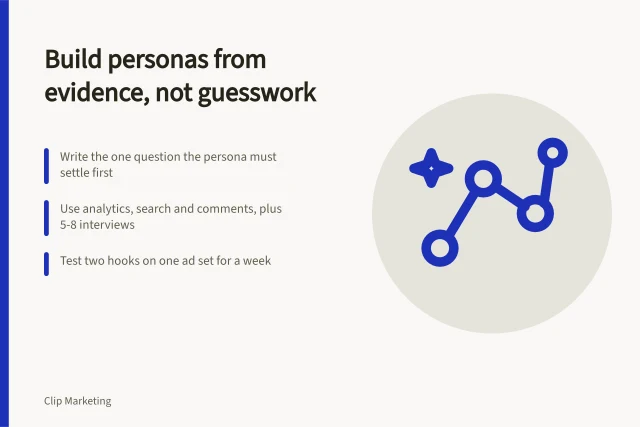
Our guide to short form video buyer personas in England includes a template and worked examples for B2B and consumer brands.
Test each persona against a real decision. Would this person watch a 45-second explainer or a 12-second demo? If the persona cannot answer, it is too vague.
Choose channels with evidence
Channel choice should follow the audience, not the trend. LinkedIn's advertising platform documents audience targeting for reaching professionals, letting you narrow by job function, seniority and industry. That is a different audience from the one scrolling entertainment feeds at 9pm.
Choosing how many channels
Can you resource this channel properly?
Run it well and collect one trusted data set
Drop it rather than run three badly
Vertical video behaves differently on each platform. Aspect ratio, safe zones, caption placement and sound-on habits all vary. Test one format across two channels before committing budget to either.
Budget constrains the answer as much as audience does. Running three channels badly costs more than running one properly, and it leaves you with three thin data sets instead of one you can trust.
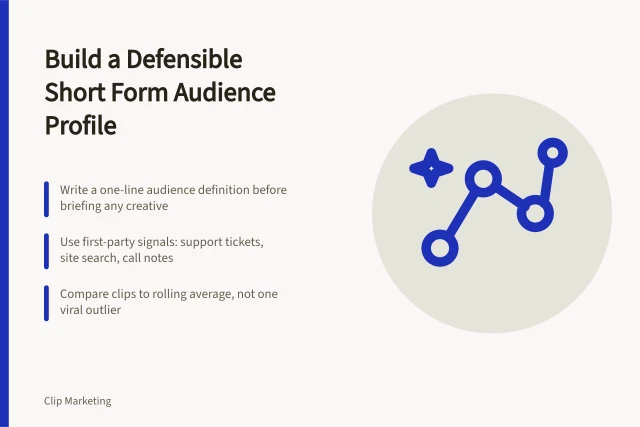
For a fuller picture of where your target sits, see our guide to defining your short form video target audience in England, which sets out the trade-offs between reach and relevance.
Creative that fits the feed
Audience research should change how the advert looks, not just who sees it. IAB UK publishes native distribution creative best practices covering how paid content should match the surrounding editorial style. The principles apply to short form video as much as to written native ads.
Creative that fits the feed
- Match the platform's native look
- Assume sound off until research says otherwise
- Write captions that work without audio
- Check safe zones for interface overlap
- Match first frame to native style
- Logdate, hook, persona, spend, 3-second retention
The practical translation is simple. If the audience expects a person speaking to camera in a home setting, a studio voiceover will feel like an interruption. If they expect product detail, a vague lifestyle clip wastes their time.
Assume sound off until your research says otherwise, and write captions that make sense without the audio. Then check the safe zones so text is not hidden behind the platform's interface.
Match the first frame to the platform's native look, then earn attention with the content. Research tells you what that look is for your audience.
Keep a simple test log: date, hook, persona, spend, retention at three seconds. Ten rows of that log will teach you more than any opinion in a planning meeting.
Measure and feed it back
Set three measures before launch: hook retention at three seconds, completion rate, and one commercial action such as a click, save or enquiry. Anything else is commentary.
Three measures to set before launch
- 3 secondshook retention
- Completion rateshare watching to the end
- 1commercial action click, save or enquiry
Compare results by persona and by channel. If the persona you built for cost-conscious buyers responds to a value-led hook and not a premium one, that is a finding worth writing down.
When results contradict a persona, trust the results. The persona was a hypothesis. Correct it in writing, date the change, and tell whoever briefs the creative work.
Run a review after every campaign and update the persona page. Research is a loop, not a project. Teams that revisit their notes quarterly make better videos than teams that start from scratch each time.
For planning beyond the current quarter, our outlook on short form video trends in England for 2027 maps the shifts worth preparing for now.
Glossary
- Hook
- the opening moment of a video, usually the first one to three seconds.
- Retention
- the share of viewers still watching at a given point.
- Persona
- a one-page profile of a typical buyer, built from research.
- Native distribution
- paid content styled to match the platform it appears on.
- Completion rate
- the share of viewers who watch a video to the end.
- Desk research
- findings gathered from published sources rather than new fieldwork.
Common questions
How many interviews are enough?
Eight to twelve is usually enough to hear the same themes repeat. If every conversation raises a new issue, keep going. If the last three add nothing, stop and write up.
Can published data replace talking to people?
No. National statistics tell you who is on a platform and roughly how often. They cannot tell you why your customer skipped your last video. Use both.
What should a persona actually contain?
One page with a name, situation, goal, main barrier, platform habit and buying trigger. If it runs to four pages, nobody on the team will read it before an edit.
How often should we repeat this research?
Review the persona notes after every campaign and refresh the published data annually. Platform habits move faster than national surveys, so watch your own retention figures between reviews.
In this guide
- How to build a short form video target audience profileLearn how to build a short form video target audience profile using first-party data, IAB UK standards and ASA guidance before you brief a single edit.
- Build short form video buyer personas from evidence, not guessworkShort form video buyer personas work best when built from search data, interviews and platform signals, with consent handled under UK GDPR rules.
- What short form video customer interviews mean for audience researchA practical listicle on running short form video customer interviews in England, covering consent, question design, recruitment and the records you keep.
- Choosing short form video survey tools without wasting your budgetCompare paid panels, native polls and boosted posts for short form video survey tools, with England costs, sample quality and a worked £1,200 example.
- Why short form video competitor research needs a proper checklistA practical checklist for short form video competitor research, covering audience signals, creative formats and the consumer law that applies to what you copy.