Rules and ethics
Part of Short-form video captions: UK accessibility requirements and best practice
Short-form video captions: UK accessibility requirements and best practice
UK video captions law explained: what the Equality Act 2010 means for subtitles on short-form video, plus practical captioning and audio description steps.
What to take away
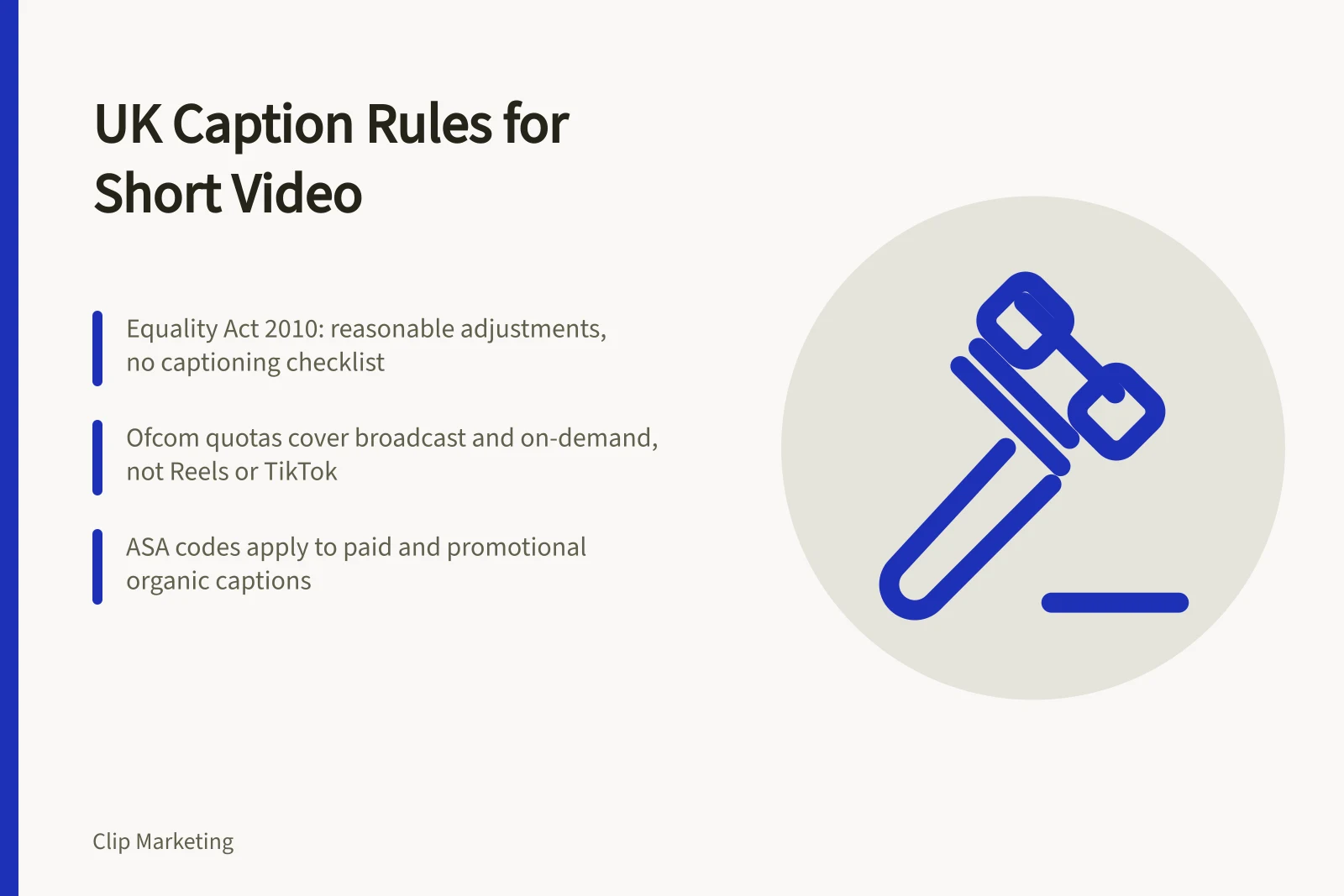
- The Equality Act 2010 creates a duty to make reasonable adjustments for disabled people, and captions are the adjustment most often discussed for video.
- Ofcom accessibility quotas cover broadcast and on-demand services it regulates, not a small firm posting Reels or TikToks.
- Advertising codes apply to every caption and on-screen text you publish, paid or organic.
- UK GDPR applies when captions or subtitles capture personal data, such as names or order numbers.
- England, Scotland and Wales share the Equality Act 2010; Northern Ireland uses different disability discrimination law.
What the Equality Act 2010 means for captions
The Equality Act 2010 contains no captioning rules. It sets duties not to discriminate and to make reasonable adjustments for disabled people. For service providers that duty sits in Part 3; for employers, Part 5. The Equality Act 2010 is a starting point rather than a checklist.
A missing caption can form part of a claim that a service was inaccessible. So can on-screen text that is too small or too brief to read. The Act sets no technical standard, and no regulator publishes a caption rulebook for social video.
What counts as reasonable depends on the size of the organisation, the cost of the fix and the resources available. Auto-captions with a manual tidy-up are usually cheap enough to be reasonable. Doing nothing is harder to defend.
This is general guidance. Individual cases need a qualified adviser, usually a discrimination or employment solicitor.
Where Ofcom fits, and where it does not
Ofcom sets accessibility requirements for television and for on-demand programme services it regulates. Those rules cover subtitles, signing and audio description. A small firm posting Reels or TikToks sits outside that regime.
Platform tooling is a separate question. TikTok, Instagram and YouTube all generate automatic captions. Accuracy shifts with accent, background noise and technical vocabulary such as product codes. Treat them as a draft, not a finished accessibility feature.
What to produce for a vertical video
Where it helps
- Burned-in captions
- Reels, TikTok and Shorts, where most viewers watch muted
- Platform auto-captions
- Fast drafts and internal review
- Uploaded SRT or VTT file
- YouTube and sites that read caption files
- Audio description
- Product demos, how-to clips and training content
Watch out for
- Burned-in captions
- Cannot be edited after export
- Platform auto-captions
- Mistakes on names, prices and accents
- Uploaded SRT or VTT file
- Timing drifts after a re-cut
- Audio description
- Needs extra script lines
Most UK small teams can start with two of these: burned-in captions for the vertical edit, plus a transcript on the page where the video is embedded. Vertical framing leaves less room for text, so shorter caption lines work better on a phone. If you also film product footage, the guide to short-form video product demos for UK ecommerce explains how to script the visual steps that captions then describe.
Caption formats compared
Burned-in captions
- Best for
- Reels, TikTok, Shorts
- Watch out for
- Cannot edit after export
Platform auto-captions
- Best for
- Fast drafts
- Watch out for
- Names, prices, accents
Uploaded SRT or VTT
- Best for
- YouTube and sites
- Watch out for
- Timing drifts after re-cut
Advertising and data protection when you caption
Captions are advertising when they promote something. The UK advertising codes cover paid social and promotional organic posts, and the ASA regularly rules on unclear pricing and qualifications. Keep prices and deadlines on screen long enough to read.
Data protection bites when a caption carries personal data. A first name at the edge of frame or a visible order number counts. The ICO's guide to UK GDPR explains lawful bases and individual rights. Permission to film someone is not automatically a lawful basis for that data.
A caption workflow for a small team
- Write the script so the words carry the message on mute.
- Capture clean audio, because captions inherit every mumble.
- Generate auto-captions, then correct names, numbers and product terms.
- Check size, contrast and line length on a phone screen.
- Upload an SRT where the platform supports it.
- Publish a transcript and date your review.
The stage that saves the most time is the first. Teams that plan caption lines while writing short-form video scripts for UK brands tend to spend less time fixing auto-caption errors later.
Six-step caption workflow
- Write script so words work on mute
- Capture clean audio for accurate captions
- Generate auto-captions, correct names and numbers
- Check size, contrast and line length
- Upload SRT where supported
- Publish transcript and date review
Common questions
Does the Equality Act 2010 require captions on every video?
No. It requires reasonable adjustments where a disabled person would otherwise be at a substantial disadvantage. A short internal clip may need nothing; a public information video with speech usually needs captions.
Do platform auto-captions meet accessibility standards?
There is no single UK standard for social captions, so the test is whether a viewer can use the video. Auto-captions that mangle key words fail that test, even when the platform supplies them.
Does the law differ across the UK?
The Equality Act 2010 covers England, Scotland and Wales. Northern Ireland has separate disability discrimination law, so check the position there before you publish a UK-wide campaign.
What should a small business caption first?
Start with videos that carry instructions, prices or safety information. Those are the clips where a viewer who cannot hear the audio loses the most.