Outlook
Part of What the short form video outlook for 2027 means for England
Short form video AI applications explained for marketers
How AI features in short form video tools handle captions, rough cuts and variant testing, plus the checks, costs and update triggers UK teams need.
What to take away
Short form video AI applications are software features that draft, edit, caption or analyse vertical video, with a person approving whatever is published.
- Most useful todaytranscription, captions, rough cuts and quick variant testing.
- The advertiser stays responsible for claims, disclosures and rights, whatever tool made the cut.
- Review time is a real cost. Budget hours for checks, not just software seats.
- Agree update triggers in advancepricing changes, platform policy changes and model changes.
- Test one platform and one format first, so the tooling proves itself before you buy wider access.
Where AI fits the workflow
The strongest use case is speed at the boring stages. Transcription and captioning turn a raw interview into searchable text in minutes. Auto-reframing crops a wide shot into a 9:16 frame for vertical feeds.
Rough cuts come next. A tool can assemble a first pass from transcript highlights, which gives an editor something to react to. Judgement about pacing, tone and hook still sits with a person.
Script drafting is more mixed. Models produce plausible openings fast, but they flatten brand voice unless you feed them examples. Treat the first draft as raw material rather than a finished script.
Voice and music features are the least settled area. Synthetic narration is quick to produce, yet audiences notice when a presenter sounds unlike themselves. Get written consent before cloning anyone's voice.
Variant testing is where AI earns attention. Generating ten caption lines or thumbnails is cheap. Deciding which one matches your positioning is not. Our short form video trends and outlook for England in 2027 sets out the market shifts that make this routine.
Pick the smallest slice that removes the most repetitive work. For a two-person team, that is usually transcription and captioning rather than a full editing suite with seats nobody uses.
Four application types compared
Four AI application types compared
Transcription and captions
- Typical use
- Speech to text
- Main risk
- Misheard brand names
- Check before publishing
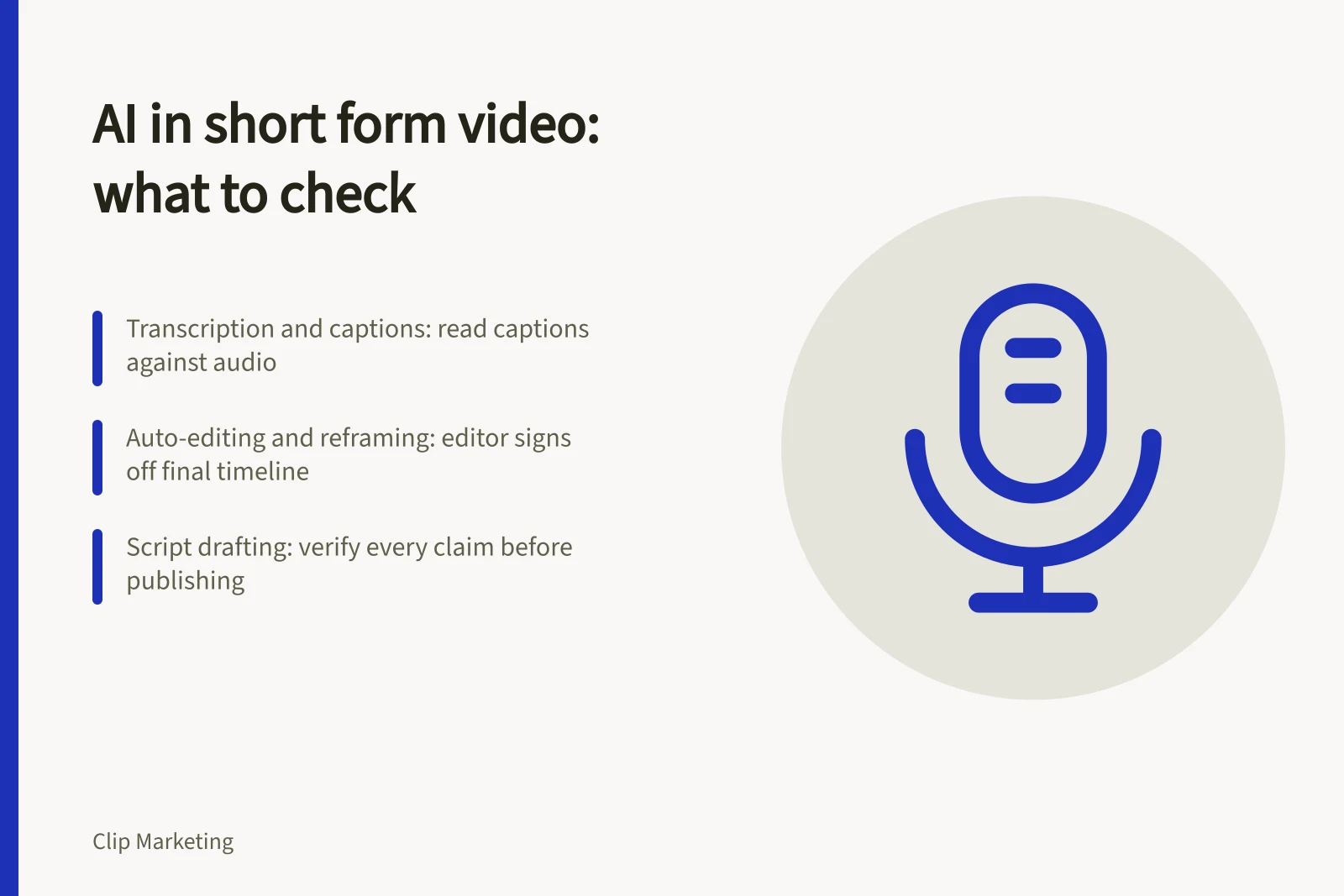
- Read captions against audio
Auto-editing and reframing
- Typical use
- First cut and 9:16 crop
- Main risk
- Awkward cuts, cropped faces
- Check before publishing
- Editor signs off timeline
Script and hook drafting
- Typical use
- Opening lines and outlines
- Main risk
- Generic claims, tone drift
- Check before publishing
- Verify every factual claim
Performance analysis
- Typical use
- Summarising retention and comments
- Main risk
- Patterns from thin data
- Check before publishing
- Confirm sample size
Typical use
- Transcription and captions
- Turning speech into text and subtitle files
- Auto-editing and reframing
- Building a first cut and cropping to 9:16
- Script and hook drafting
- Generating opening lines and outlines
- Performance analysis
- Summarising retention and comments
Main risk
- Transcription and captions
- Misheard brand names and figures
- Auto-editing and reframing
- Awkward cuts and cropped faces
- Script and hook drafting
- Generic claims and tone drift
- Performance analysis
- Pattern spotting from thin data
Check before publishing
- Transcription and captions
- Read captions against the audio
- Auto-editing and reframing
- Editor signs off the final timeline
- Script and hook drafting
- Verify every factual claim
- Performance analysis
- Confirm sample size with a human
Review, rights and disclosure
Whatever the tool, someone signs off the published video. Marketing guidance from the Chartered Institute of Marketing content hub treats video planning as a strategy decision. The brief and the approval route matter as much as the editing.
Digital advertising standards do not change because a model wrote the first line. The IAB UK standards and guidelines set out industry expectations for digital advertising, including video, and they apply to AI-assisted creative in the same way.
Consumer protection law sits behind all of this. The Competition and Markets Authority enforces consumer protection and competition law, so an AI-written line about a product still needs evidence. Keep a record of the source for every claim.
Keep that record dated too. A short note of which tool produced which cut, and who approved it, settles arguments quickly if a complaint arrives months later.
Cost and update triggers
Software pricing moves quickly. For example, a team paying £300 a month for editing seats may find the same features bundled elsewhere within a year. Figures like that belong in a review, not a forecast.
Watch how seats are counted too. A plan priced per editor gets expensive once freelancers need access. Read the terms before renewing.
A bundled suite rarely replaces a specialist tool outright. Check what you actually open each week before paying for a higher tier. Run a paid pilot on live work before committing to a full year.
Set triggers rather than relying on an annual rethink. Revisit tooling when a platform changes its video specifications or a vendor changes pricing. Our guide to short form video 2027 trends data and sources explains how to keep the evidence behind those decisions dated and checkable.
Common questions
Does AI remove the need for an editor?
No. It removes some repetitive work, particularly transcription and first-pass assembly. The final cut, the claims and the brand fit still need a named person to approve them.
Which tasks should stay manual?
Hooks, factual claims and anything touching regulated products. These carry the most risk and the least tolerance for a plausible-sounding draft.
How often should we review our tooling?
At least when a platform updates video specifications or a vendor changes pricing. Tying reviews to events is cheaper than a standing quarterly project.
Do UK rules single out AI video?
Not as a separate category. Advertising and consumer rules apply to the outcome, so disclosure and evidence duties follow the published video.