Costs and pricing
Part of Budget for short form video costs and pricing with a working model
When to add short form video hidden costs to the budget
Costs that land after the quote: versioning, paid reach, rights and compliance review, with illustrative pound figures and a before-and-after budget table.
What to take away
- UK regulators publish their rulings and marketing guidance openly, so the compliance side of a video budget can be priced from evidence rather than guesswork.
- That matters because the costs that break a short-form video budget arrive after the quote is signed, not inside it.
- Versioning, paid reach, rights and compliance review are the lines most often left out.
- A labelled contingency of 15 to 25 per cent, tracked against invoices, is the practical guard.
- Buy reach on purpose or leave it out; it rarely costs less than the shoot.
The test this list applies
Two criteria decide what belongs here. A cost must fall due after the production quote is agreed, or continue once the campaign ends. It must also attach to something a client recognises: a finished cut, a paid impression, a substantiated claim, or an asset still running next quarter.
Does this cost belong here?
- Falls due after the quote is agreed
- Continues once the campaign ends
- Attaches to a finished cut
- Attaches to a paid impression
- Attaches to a substantiated claim
- Attaches to an asset still running next quarter
Geography matters for the compliance items only, while the advertising codes and data rules apply across the UK, so England, Scotland, Wales and Northern Ireland share the same framework. Every figure is in pounds sterling and labelled as illustrative unless a source is named.
The short form video costs and budget guide for England carries the full category list. Start here if you are building this in a spreadsheet.
The costs that arrive after the quote
A quote covers the idea, the shoot day and one edit. The work that makes a video function as marketing often sits outside it. Ask of each line below whether it would still fall due if the shoot were postponed; if it would, treat it as a budget line.
Versioning, captions and cutdowns
One shoot rarely produces one video. A 60-second master becomes a 15-second cut, a square cut and a silent-first version with burned-in captions. Each is an edit at the same day rate that made the master expensive.
Caption finishing is where the cost hides most comfortably. Machine captions still need a pass for names, figures and brand terms. Budget roughly £75 to £150 per delivered version for finishing, then multiply by the versions the media plan needs. A team paying £400 a month for editing support is buying exactly this, as a retainer.
Paid amplification, rights and compliance
Organic reach does not scale with ambition, so most plans add paid support. Keep it separate from production, because it recurs monthly and it is the first line cut when results are questioned. Rights are the second surprise: licensed music, stock footage and talent windows expire, and renewal is a fresh cost.
Compliance review is the third. If an ad claims a product benefit, a price or an environmental gain, someone must hold the evidence. The UK's statutory climate targets sit in the Climate Change Act 2008, so a green line in a script needs substantiation before filming rather than after.
Reading published ASA rulings is the cheapest way to see how the codes apply to vertical ads and influencer posts. Where a campaign collects enquiries through a comment reply or a lead form, the ICO's direct marketing guidance explains when consent is needed before that follow-up.
Smaller lines to price: talent and location releases, archiving, community management on posting days, and refreshes when a creative stops performing.
Before and after: the same campaign, two budgets
Figures are illustrative, in pounds sterling.
Before and after: two budgets
Quote only
- Creative production
- £4,000
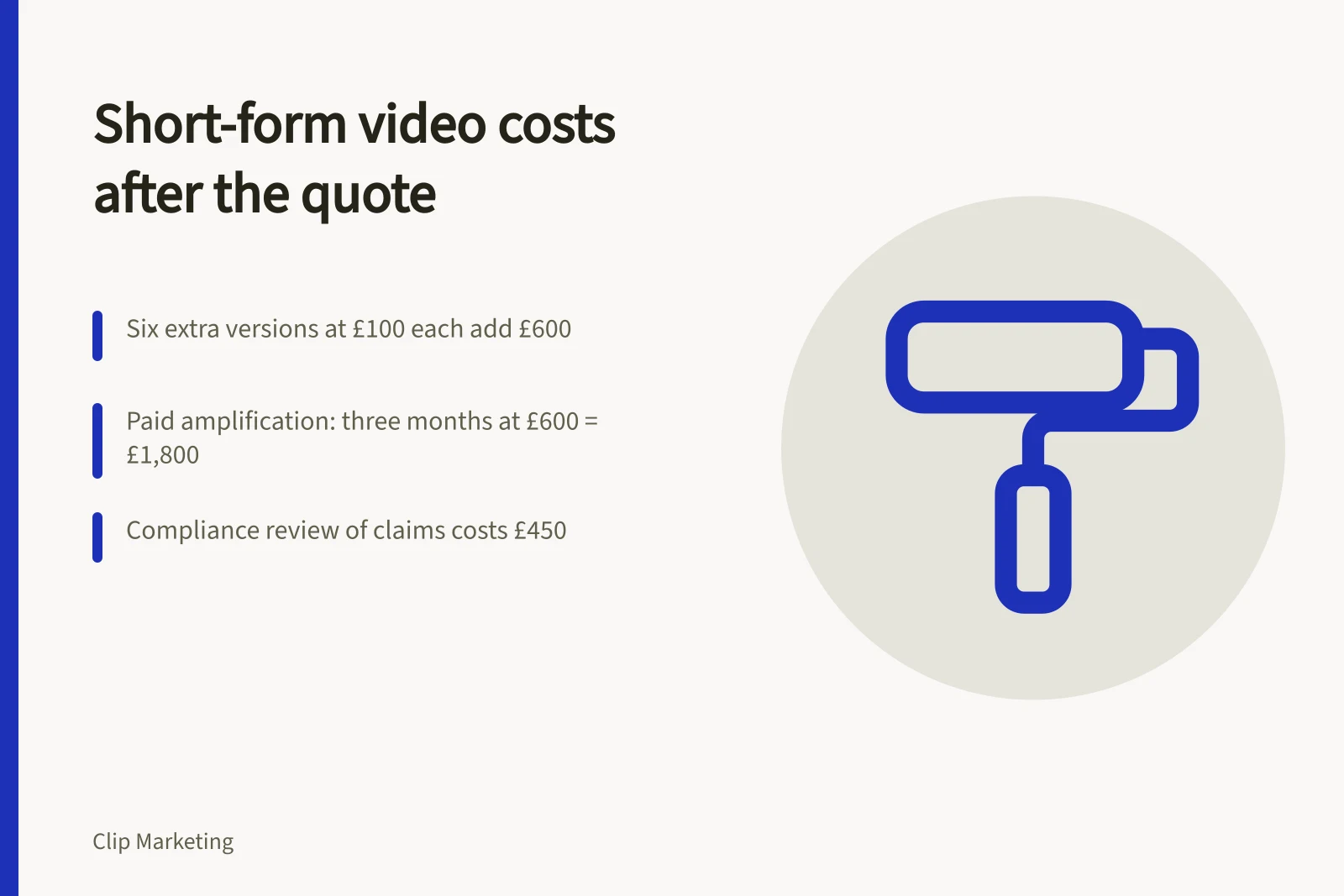
- Six extra versions at £100 each
- not listed
- Paid amplification, three months at £600
- not listed
- Subtitle and accessibility pass
- not listed
- Compliance review of claims
- not listed
- Contingency at 20 per cent
- not listed
- Quarter total
- £4,000
With hidden costs
- Creative production
- £4,000
- Six extra versions at £100 each
- £600
- Paid amplification, three months at £600
- £1,800
- Subtitle and accessibility pass
- £300
- Compliance review of claims
- £450
- Contingency at 20 per cent
- £800
- Quarter total
- £7,950
The gap between the columns is the point. A £4,000 quote becomes a £7,950 quarter, and only one of those numbers survives contact with finance if it arrives as a surprise.
Common questions
Are hidden costs just a contingency?
No. A contingency covers uncertainty; these lines are predictable. Versioning, paid reach and rights renewal happen on most campaigns, so they belong in the base budget.
Do these rules differ across the UK?
The advertising codes and data protection rules cited above apply UK-wide, so Scotland, Wales and Northern Ireland follow the same framework as England. Local differences tend to be practical, such as venue permissions.
Should paid amplification sit in the production budget?
Keep it separate. Production is a one-off cost, while amplification is monthly. Mixing them hides the true cost of reach and obscures whether the creative or the spend is doing the work.
How do I justify the extra spend internally?
Tie each added line to output. More versions mean more testing, and compliance review lowers the risk of a ruling against the brand. The short form video return on investment in England shows how to frame those outputs fairly.