Outlook
Part of What the short form video outlook for 2027 means for England
Plan for a ban or a budget cut, short form video risk scenarios
Guide to short form video risk scenarios for English marketing teams, covering platform, regulatory, cost and data risks with warning triggers and responses.
What to take away
- If a platform changes its monetisation rules or reach algorithm overnight, an English team with one channel loses most of a quarter's pipeline.
- Regulatory risk in England is mostly about data and disclosure, not the video: consent for email follow-up, ad labelling, and how you handle comments and DMs.
- Cost risk is quieter. For example, a £2,500-a-month vertical video retainer can double once amplification and revisions are added.
- You need four scenarios, not a full risk register. Each one gets a named trigger and a pre-agreed response.
- The short form video trends and outlook for England in 2027 sets the context these scenarios sit inside.
Platform risk: reach, rules and removals
Platform risk is the one English teams feel first. A change to how a feed ranks vertical video, or tighter monetisation eligibility, can cut organic reach within days.
Reach drop response
Reach per post falls four weeks?
Move budget, pause creators
Keep monitoring reach
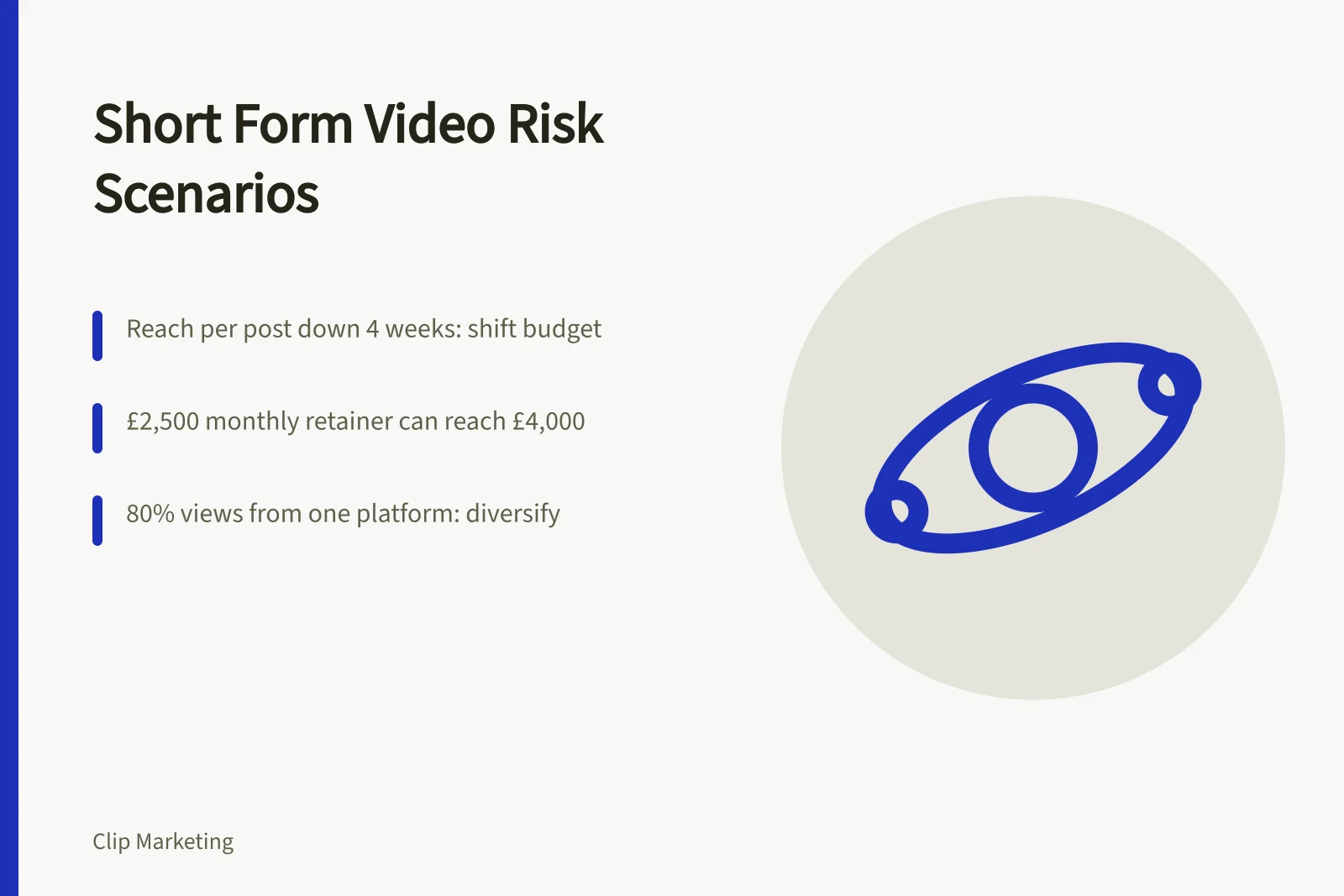
Set a trigger: if reach per post falls by a set percentage over four consecutive weeks, move budget to your second channel and pause new creator contracts. Agree the threshold in advance.
Keep every asset and caption outside the platform. If an account is suspended, you still own the material and can repost elsewhere while you appeal.
Regulatory and data risk in England
Most compliance exposure sits behind the video, not in it. Collecting emails through a lead form attached to a short-form campaign is direct marketing. The ICO step-by-step guide to direct marketing for your small business explains the consent and record-keeping basics that apply.
Regulatory and data checks
- Consent and record-keeping basics
- Clear paid partnership labelling
- Written caption approval record
- Retention schedule for comments and DMs
Disclosure is the second area. Paid partnerships need clear labelling, plus a written record of who approved each caption and when.
Comments and direct messages are a third. If you store or reuse them, that is personal data. Decide who owns the retention schedule before the campaign starts.
Scenario: a complaint about consent
A viewer signs up through a lead form, then gets a marketing email they did not expect. Your response depends on what you recorded at sign-up. If consent was bundled with a competition entry and never separately evidenced, suppress the contact and review the form.
Scenario: an influencer post is pulled
The platform removes a paid post for missing disclosure. Your exposure is reputational and contractual, not criminal. Check the brief and the approval trail, then decide whether the creator or the agency carries the correction cost.
Cost and budget risk
Cost risk rarely appears as a single bad invoice. It appears as scope creep: extra edits, extra formats, extra paid amplification. A retainer of, for example, £2,500 a month can reach £4,000 once boosting and a second aspect ratio are added.
Agree a revision CAP per asset and a separate line for amplification, reviewed quarterly.
If you buy media programmatically, the IAB UK Back to Basics Guide to Programmatic is a useful starting point for how inventory, data and fees interact.
Audience and channel risk
Concentration risk applies to audiences too. If 80% of your views come from one demographic on one platform, a shift in that audience's behaviour hits hard.
Diversify deliberately. For professional audiences alongside consumer reach, LinkedIn audience targeting lets you define job function, seniority and industry.
Track the source of your best-converting viewers monthly. If one source drops below a set share, test a new format or channel.
Scenario planning in practice
Write four scenarios, each on one page: platform rule change, data or consent complaint, cost overrun, audience shift. Name the trigger, the owner and the first action.
Review the triggers monthly. If two fire in the same quarter, slow new commitments rather than push harder.
Where you need dated figures to justify a scenario, use the short form video 2027 trends data and sources rather than internal guesswork.
Glossary
- Triggera measurable event that starts a pre-agreed response.
- Concentration riskover-reliance on one platform, creator or audience segment.
- Disclosureclear labelling that content is paid or sponsored.
- Retention schedulehow long you keep personal data and why.
- Scope creepcosts rising through added work, not higher rates.
Common questions
How many risk scenarios does a small team need?
Four is usually enough: platform, regulatory or data, cost, and audience. More than that and nobody maintains them.
When should we review the triggers?
Monthly, in the same meeting where you review performance. Triggers that are never checked are just notes.
Does this apply outside England?
Data protection rules apply across the UK, though some enforcement detail differs in Scotland, Wales and Northern Ireland. Platform and cost risks are the same everywhere.