Outlook
What the short form video outlook for 2027 means for England
What the short form video outlook for 2027 means for England, covering regulation, platform economics, production costs and the update triggers to watch.
What to take away
- The outlook for short form video in England in 2027 is shaped less by new formats than by three forces: platform economics, advertising rules that apply to vertical video, and the cost of staying visible.
- Nothing in the UK advertising rulebook is expected to change for short-form video in 2027. The Equality Act 2010 already prohibits discrimination in advertising, including video content, so the creative review you run now is the one you will need next year.
- Budget planning should assume rising production volume rather than rising production quality. For example, a team paying £400 a month for editing support in 2026 should model a higher figure if it doubles output in 2027.
- Distribution questions are the real 2027 risk. Broadcasting and video on-demand rules affect how video content moves between the UK and the EU, and that matters if you syndicate brand video across markets.
- Treat every forecast in this guide as a scenario, not a promise. The section below lists the update triggers that should send you back to the plan.
The 2027 short form video outlook is not about a new app. It is about arithmetic, because vertical video is now how UK audiences meet brands.
The constraint on most marketing teams is no longer whether to publish short-form video. It is how much they can fund, clear and distribute under advertising rules in England, Scotland, Wales and Northern Ireland.
That shift matters because the economics changed first: platforms now run on cheap reach and costly consistency, while one well-made vertical video can still travel. Teams that hold attention publish several times a week, month after month.
The 2027 outlook follows: more volume, tighter budgets, and a compliance process that must keep pace.
Why the 2027 outlook changed in 2026
Three changes in the last eighteen months reset the baseline.
First, vertical video stopped being a format choice. It is now the default aspect ratio across the major social platforms, and horizontal edits are increasingly the exception for paid social. That change is structural, not seasonal, and it will still be true in 2027.
Second, the cost of production fell unevenly. Editing tools got cheaper and faster, while the cost of creative direction, legal review and paid amplification did not. Marketing teams therefore face a split budget: plenty of cheap footage, not enough people to decide what to do with it.
Third, the regulatory picture stayed stable, which is itself a signal. The advertising codes administered by the Committee of Advertising Practice and the Advertising Standards Authority continue to apply to video content wherever it runs, including vertical social formats. Nothing in the 2026 pipeline suggests a carve-out for short-form video in 2027.
The practical consequence is that strategy questions in 2027 will be about capacity and governance, not novelty. If you want the wider picture of how budgets and channels sit together, our short form video market outlook in England sets out the demand-side view in more detail.
How will UK advertising rules apply to vertical video?
The rules are format-neutral. If a video is an advertisement, it is covered, whether it runs for six seconds on a social feed or sixty seconds on a broadcaster's on-demand service. The Equality Act 2010 prohibits discrimination in advertising, including video content, which means casting, scripting and targeting decisions all sit inside the same legal frame.
In practice, short-form teams face three recurring problems. Humour that relies on a stereotype can fail harm and offence rules, even with benign intent. Targeting settings can narrow an audience and create discrimination risk if the creative implies who the product is for.
Reusing user-generated footage in paid video brings third-party content into the ad, with its own compliance questions.
The fix is procedural rather than expensive. A short checklist before publishing covers claims, casting, music rights and targeting. It catches most problems.
Teams that run it at script stage, not upload stage, spend less time re-editing. Rules do not change because video is vertical, and 2027 will not bring a lighter regime for social formats.
What does the platform and ad market picture look like?
Platform incentives in 2027 will continue to reward watch time over polish. That has two consequences for planning. Organic reach stays achievable for teams that publish often, and paid reach stays affordable for teams that accept lower production values in exchange for volume.
The industry body for digital advertising has documented how that market developed and how its membership of publishers, agencies and platforms shaped measurement and standards. The IAB UK account of its own role and history is a useful starting point if you need to explain to a finance director why digital video budgets are structured the way they are.
For business-to-business marketers, the picture differs again. LinkedIn is the main platform where vertical video reaches a named job function rather than an interest category. Its self-serve video ad options let a small team test creative without a media agency.
Read the LinkedIn Ads overview before you commit a budget. The targeting mechanics reward narrow audiences and penalise broad ones.
The 2027 forecast most teams should plan against is therefore not a single number. It is a split: high-volume, low-cost video for awareness, and lower-volume, higher-cost video for considered purchases.
What will short form video cost in 2027?
Cost is where most forecasts go wrong, because they quote day rates rather than annual totals. A workable 2027 model has four lines: capture, edit, clearance and amplification.
Illustrative monthly cost lines
- £1,200editing
- £300music and stock licensing
- £1,500paid amplification
- £3,000total per month
Capture is the cheapest line if you already have a phone, a window and someone willing to appear on camera. Edit is the line that scales with volume, and it is the one that catches teams out. Clearance covers music, footage and contributor permissions. Amplification is the paid budget you put behind the best organic performers.
For example, a small England-based team publishing three vertical videos a week might spend £1,200 a month on editing, £300 on music and stock licensing, and £1,500 on paid amplification. That gives a labelled illustrative total of about £3,000 a month.
A team publishing once a week might spend a third of that and reach far fewer people. Our costs and budget guide for England breaks these lines down further if you need a figure to take into a planning meeting.
The direction of travel for 2027 is that the edit line grows while the capture line stays flat. Budget reviews that only look at equipment will miss the pressure.
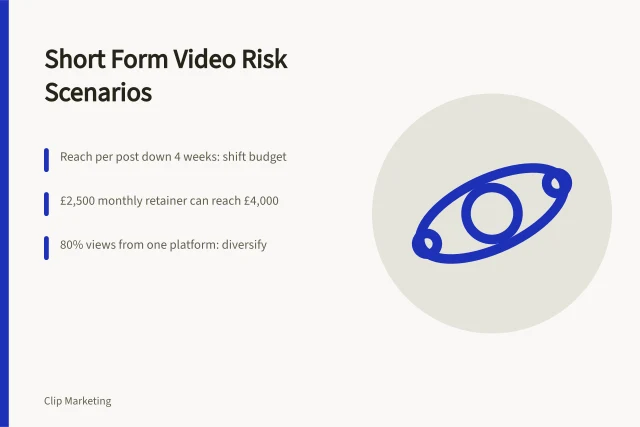
What are the main risk scenarios to plan for?
Four scenarios are worth writing down now, because each has a different response.
The first is a platform changing its recommendation logic in a way that reduces organic reach for brand accounts. The response is to diversify the publishing surface rather than to increase volume on a single platform.
The second is a regulatory or enforcement shift that raises the cost of paid targeting. The response is to build first-party audiences so that reach does not depend entirely on platform interest categories.
The third is a production bottleneck, usually an editor leaving or a freelancer raising rates. The response is to document your edit templates so that a replacement can pick them up.
The fourth is a distribution problem in a second market. Broadcasting and video on-demand services between the UK and the EU follow specific rules. The GOV.UK guidance on broadcasting and video on-demand services between the UK and EU explains where those obligations sit.
If your 2027 plan includes running the same vertical campaign in Ireland or Germany, read that page before you brief the creative.
We set out more of these in our short form video risk scenarios in England, including the ones that are easy to overlook when a campaign is performing well.
Where does AI fit in the 2027 plan?
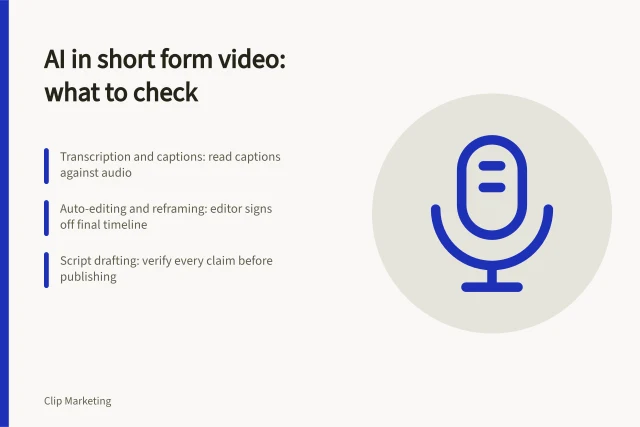
AI in short-form video has moved past novelty into two practical uses: editing assistance and variant generation. Editing assistance covers captions, cuts and rough assembly. Variant generation covers producing several openings for the same footage so that a team can test hooks without reshooting.
Both uses change the cost model rather than the strategy. If a tool can produce ten variants from one shoot, the constraint moves to deciding which variant to run and how to measure it. That is a media planning problem, not a production one.
The risks are equally practical. Generated voice and likeness need contributor consent. Auto-captions need checking against brand names. And any claim that appears in a generated script is still a claim under the advertising codes. Our guide to AI applications in England covers the workflow questions in more depth, including where human review should sit.
For 2027, the sensible assumption is that AI reduces the marginal cost of each additional video but does not reduce the cost of the first one. Planning should reflect that asymmetry.
How should you structure a 2027 short form video plan?
Start with a volume target expressed as videos per week, not hours of footage. Volume is the variable that drives reach and the one you can actually control.
Three format choices for 2027
Vertical social video
- Typical length
- 6 to 60 seconds
- Main cost driver
- Edit volume and paid amplification
- Best use in 2027
- Awareness and repeat reach
Vertical video for B2B
- Typical length
- 15 to 90 seconds
- Main cost driver
- Creative direction and targeting
- Best use in 2027
- Considered purchases and lead generation
Horizontal brand video
- Typical length
- 60 seconds and over
- Main cost driver
- Not stated
- Best use in 2027
- Not stated
Then set a clearance process with named owners. One person signs off claims, one signs off music and footage, one signs off targeting. On a small team, the same person can hold two roles, but the steps should be written down.
Then allocate budget in the four lines described above and review quarterly. The review should ask which line grew fastest and whether the growth bought reach.
Finally, set update triggers. These events should send you back to the plan rather than waiting for the annual review.
Useful triggers include a change to platform monetisation rules, a new ASA ruling in your category, a shift in the cost of your main editing resource, and any change to how your video reaches UK and EU markets.
A comparison table helps when you present the plan. The table below sets out how the three main format choices differ for a 2027 plan in England.
2027 short form video plan
Typical length
- Vertical social video
- 6 to 60 seconds
- Vertical video for B2B
- 15 to 90 seconds
- Horizontal brand video
- 60 seconds and over
Main cost driver
- Vertical social video
- Edit volume and paid amplification
- Vertical video for B2B
- Creative direction and targeting
- Horizontal brand video
- Production and clearance
Best use in 2027
- Vertical social video
- Awareness and repeat reach
- Vertical video for B2B
- Considered purchases and lead generation
- Horizontal brand video
- Website, events and sales enablement
The table is a planning aid, not a rule. Some campaigns will sit across all three rows, and the compliance steps are the same in each case.
Which sources should you track through 2027?
The outlook will change as new data arrives, so the useful skill is knowing which sources to check and how often.
Four numbers to track monthly
- Videos published
- Cost per video
- Cost per thousand reached
- Share of reach from paid
For marketing practice and industry reporting, the CIM articles and reports library publishes regular analysis of social media and short-form video that is written for UK practitioners rather than for platform advertisers.
For regulation, the primary source is legislation.gov.UK, which holds the full text of the Equality Act 2010 and any amendments. For distribution across markets, GOV.UK guidance is the reference point. For advertising standards, the ASA and CAP publish rulings and guidance that show how the codes are applied in practice.
For your own planning, track four numbers monthly: videos published, cost per video, cost per thousand reached, and the share of reach that comes from paid. Those four will tell you more about the 2027 outlook than any forecast article, including this one. We list the datasets and reporting cycles worth following in our 2027 trends data and sources page.
Common questions
Will short form video still work for small brands in 2027?
Yes, with a caveat about consistency. Small brands can compete on volume and specificity, but they cannot compete on production budget. The teams that do well publish regularly and accept that most videos will underperform, funding the few that travel.
Does the Equality Act 2010 apply to social media video ads?
Yes. It prohibits discrimination in advertising, including video content, and that applies to vertical social formats as much as to any other advertisement. The practical implication is that casting, scripting and audience targeting all need review before publishing.
Do I need different rules for video distributed in the EU?
Yes, if you are moving video content between the UK and the EU. Broadcasting and video on-demand services are covered by specific guidance, and the obligations differ from those that apply to purely domestic social publishing. Check the position before a campaign goes live in a second market.
How often should I revisit a 2027 short form video plan?
Quarterly is usually enough, provided you have update triggers. Revisit sooner if a platform changes its monetisation or recommendation rules, if a regulator publishes a ruling in your category, or if your main production cost changes by more than a small margin.
In this guide
- Seven short form video 2027 trends to source before you planA named list of seven short form video 2027 trends, from AI avatars to Ofcom duties, with sourced facts and practical questions for UK marketing teams.
- Short form video AI applications explained for marketersHow AI features in short form video tools handle captions, rough cuts and variant testing, plus the checks, costs and update triggers UK teams need.
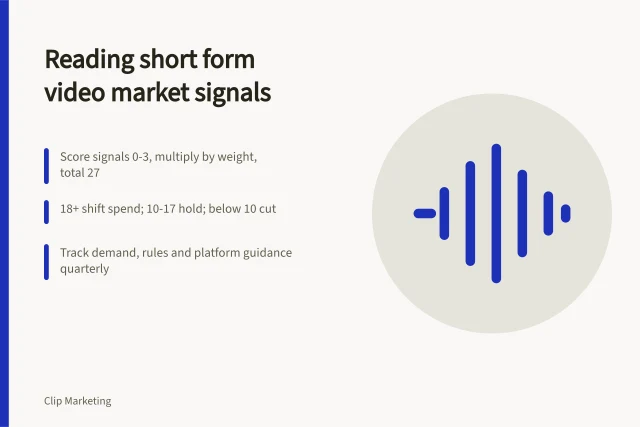
- Short form video market outlook signals every English marketing lead should trackA guide to reading short form video market outlook signals for England, covering the trigger list, rules sources and a scoring rubric for reviewing spend.
- When to refresh your short form video skills forecastHow to keep a short form video skills forecast current, with the update triggers, dated evidence and review points English marketing teams should set.
- Plan for a ban or a budget cut, short form video risk scenariosGuide to short form video risk scenarios for English marketing teams, covering platform, regulatory, cost and data risks with warning triggers and responses.