

Outlook
Glasgow and Edinburgh short form video planning around August
Short form video marketing in Scotland needs a calendar built around the Edinburgh Festival and Glasgow's summer tourism spike, not a generic UK plan.
What to take away
- Short form video marketing in Scotland fails when teams plan for a flat year and then panic in August.
- The 2026 Edinburgh Festival Fringe runs 7 to 31 August, and the Edinburgh International Festival runs 7 to 30 August.
- Glasgow's summer tourism spike arrives earlier than the Festival and rewards a separate, shorter content burst.
- Name the venues, agencies and creators you will approach before the calendar is signed off.
- Scheduling tools handle the posting; a written calendar handles the decisions.
- Report on saves, follows, site sessions and bookings, not views alone.
Why August changes short form video planning in Scotland
August is the month when Scotland's content supply and demand both peak at once. Edinburgh fills with performers, press and visitors for the Festival and Fringe. Glasgow absorbs a different wave of tourists and day-trippers. Every Scottish marketer with a camera is competing for the same streets, the same creators and the same audience attention.
The practical consequence is that the calendar has to be written backwards from the fixed event dates. If your team decides in July to film at the Royal Mile during the Fringe, you will find no crew, no affordable rooms and no clear shooting windows.
Ofcom and ONS data show near-universal household internet access across the UK, with variation in how different age groups use social platforms (ONS internet access tables). That variation should shape which platform gets your Festival content and which gets your quieter autumn work.
Paid creator content still needs ASA and CMA disclosure, but the August calendar is the planning issue.
A single August campaign usually tries to serve three audiences: locals, UK visitors and international visitors. They want different things. Locals want to know what is worth the crowds. UK visitors want logistics and atmosphere. International visitors want proof that the trip is worth the flight. One calendar, three content tracks.
If you are rebuilding your approach from scratch, the wider short form video strategy for 2027 is a sensible starting point before you map dates.
The three Scottish August audiences
What they watch
- Glasgow and Edinburgh locals
- Hidden gems, quiet alternatives, transport tips
- UK visitors
- Travel logistics, ticket advice, weather reality
- International visitors
- Atmosphere, performances, food, nightlife
Best platform
- Glasgow and Edinburgh locals
- TikTok, Instagram Reels
- UK visitors
- TikTok, YouTube Shorts
- International visitors
- Instagram Reels, YouTube Shorts
When to publish
- Glasgow and Edinburgh locals
- Late July, then weekly
- UK visitors
- June to early August
- International visitors
- May to August
Mapping the Edinburgh Festival and Fringe into a content calendar
Scottish content calendar mapping starts with the fixed points. The 2026 Edinburgh Festival Fringe runs 7 to 31 August 2026, and the Edinburgh International Festival runs 7 to 30 August 2026. Those dates are known years ahead, which makes them the easiest part of the plan.
Fringe content calendar, backwards
- Lock event dates and venue addresses
- Book creators and crew in March/April
- Draft content pillarspreviews, interviews, reactions
- Schedule cadenceheavy first ten days
- Leave two reactive slots a week
Work backwards in numbered steps:
- Lock the event dates and the venue addresses you can access, including the Royal Mile, the Pleasance, Assembly Rooms and the Traverse Theatre.
- Book creators and crew in March or April, before rates rise and availability disappears. Typical rates are £250 to £750 per short video for a micro creator, £350 to £650 per day for a freelance shooter-editor, and £700 to £1,200 per day for a two-person crew. August hotel rooms in Edinburgh typically run £200 to £400 per night.
- Draft the content pillarspreviews, day-in-the-life, artist interviews, audience reactions, behind-the-scenes and post-show wrap-ups.
- Schedule the publishing cadencethree posts per week for each audience track.
- Leave two slots a week empty for reactive content, because something always happens.
The Fringe rewards speed. A clip filmed at a 2pm show can be edited and posted by 6pm, while the conversation is live. That is only possible if editing capacity is booked in advance and someone holds the publishing rights to the account.
Not every slot needs to sell tickets. Some of the strongest performing Scottish Festival content is practical: how to get between venues, where to eat without a booking, which free shows are worth an hour. That content earns saves and shares, which then support the ticket-selling posts.
Keep a written record of what you published and why. A reusable short form video planning template makes the next August far less painful, and it forces the team to agree on pillars before filming starts.
A worked example: a ten-day Fringe sprint
Take a mid-sized Edinburgh venue with three shows and a marketing team of two. In the first week they publish one artist interview, two venue atmosphere clips and one audience reaction video. In the second week they add a ticket-offer post, a local guide to the surrounding streets and a closing-night recap.
Nothing is filmed on the day it is posted except the reaction content. The rest was shot in a single two-day block before the Fringe opened. That block is the whole trick.
Summer tourism spikes in Glasgow and how to schedule around them
Glasgow's summer tourism spike behaves differently from Edinburgh's. It builds through June and July and is driven by city breaks, concerts, football, shopping and the west coast as a day-trip base. August is still busy, but the shape of the audience is different.
Glasgow audience switch by month
- June-JulyVisitor-facing city break content
- AugustOverlaps Edinburgh, freelancers stretched
- Late August-SeptemberSwitch to local-facing content
That difference matters for short form video marketing. Glasgow content performs well when it is useful and local. Where to eat near the Hydro, how to spend a rainy afternoon, what is on at the Kelvingrove Art Gallery and Museum, why the Burrell Collection is worth the trip south of the river.
Glasgow also has a strong resident audience that does not disappear when the tourists leave. Scheduling around the spike means running visitor-facing content in June and July, then switching to local-facing content in late August and September. The same account, two different briefs.
Weather is a genuine planning variable. Scottish summer rain changes shoot days at short notice, so build in indoor backups: the Gallery of Modern Art, the Riverside Museum, the Mitchell Library, the Barrowland Ballroom for music content. A wet-weather shot list saves a wasted day.
One more scheduling point: Glasgow's event calendar overlaps with Edinburgh's in August. Creators, photographers and editors are stretched across both cities. If you need the same freelancer for both, agree the split early and put it in writing.
Glasgow scheduling pattern
- Junevisitor-facing content, transport and food guides, west coast day trips
- Julypeak visitor content, event tie-ins, hotel and venue partnerships
- Early Augustcrossover content for people visiting both cities
- Late Augustshift to local audiences and autumn programming
- Septemberreview performance and reset the calendar
Named Scottish venues, agencies and creator networks to work with
Scotland has a workable pool of venues, agencies and creator networks, but it is smaller than London's. That is an advantage for relationship building and a risk for capacity.
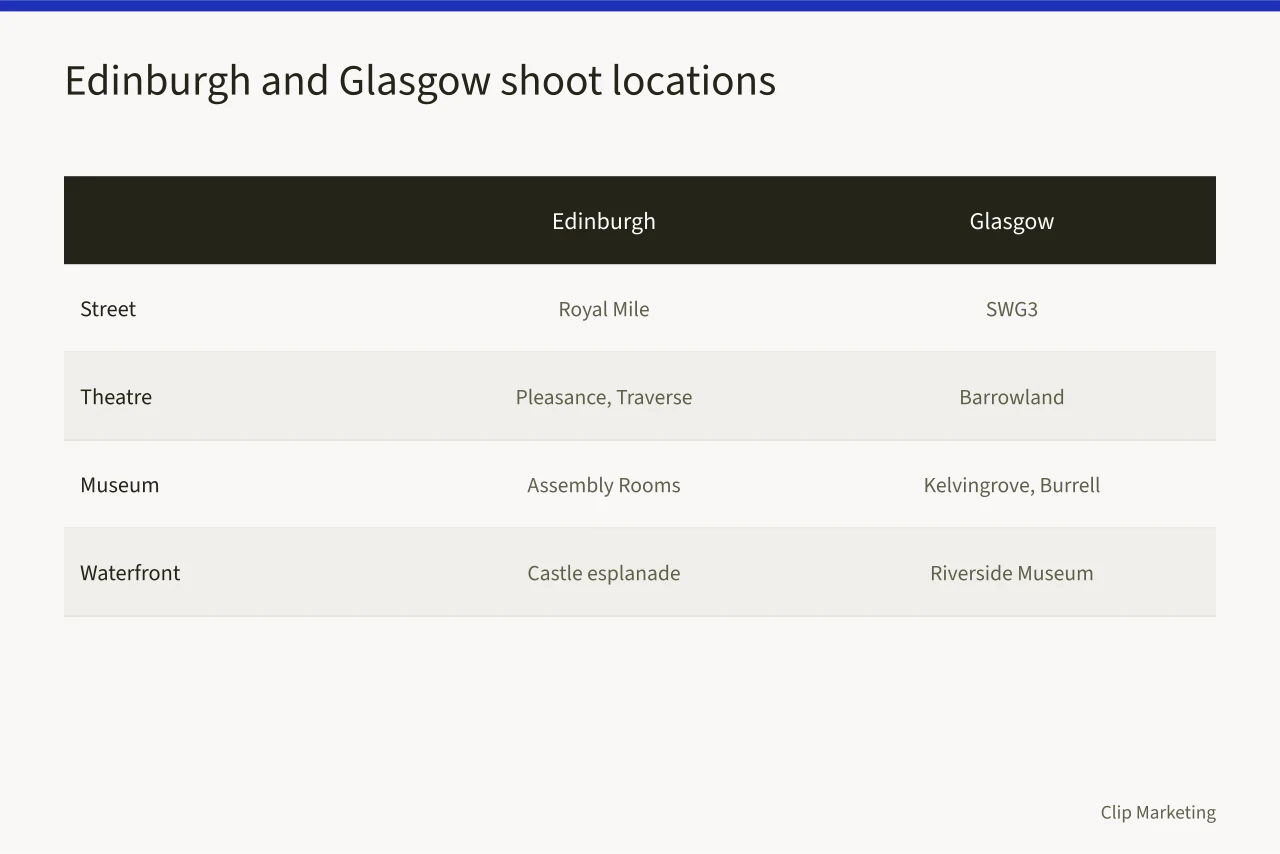
On venues, the practical short-form locations include the Royal Mile and the Pleasance in Edinburgh, the Traverse Theatre, the Assembly Rooms and the Edinburgh Castle esplanade. In Glasgow, the Riverside Museum, Kelvingrove, the Burrell Collection, SWG3 and the Barrowland Ballroom all give strong visual backdrops and are used to film crews.
On agencies, Scotland has an established independent sector. The Leith Agency, Studio Something, Frame and The Union are among the names Scottish marketers commonly work with, alongside smaller production outfits in Glasgow's Finnieston and Edinburgh's Leith. Rates vary widely, so get two or three quotes and check company status through Companies House before committing.
On creator networks, BBC The Social commissions short-form work from Scottish creators, and individual creators such as Jamie Genevieve and The Chaotic Scot are worth briefing. Direct outreach plus the platforms' own creator marketplaces also works. TikTok's creator and business resources are a reasonable starting point for briefing creators on format and disclosure (TikTok For Business).
Disclosure is not optional. Paid partnerships must be clearly labelled under ASA and CMA rules, and the creator contract should say who holds the footage rights. The IPO's copyright guidance is the reference point if you plan to reuse creator footage in paid ads.
If your team is small, the short form video channel strategy question of which platforms to actually run is worth settling before you brief anyone.
What to agree with a Scottish creator
- Deliverables, formats and aspect ratios
- Shooting dates and weather contingency
- Disclosure wording and placement
- Usage rights and duration
- Payment terms and IR35 status where relevant
Platform scheduling tools for a Scottish seasonal calendar
Scheduling tools do not fix a bad calendar, but they stop a good one from falling apart in a busy month. The choice matters less than the discipline of using one place for everything.
Scheduling tool options
Native
- Platforms
- Meta, TikTok, YouTube
- Approvals
- Limited
- Calendar view
- Per platform
- Reschedule speed
- Fast in-app
Third-party
- Platforms
- Cross-posting
- Approvals
- Workflow support
- Calendar view
- Shared view
- Reschedule speed
- Varies by tool
Most Scottish teams end up with a mix. Native schedulers inside Meta Business Suite and TikTok handle the platforms they own. Third-party tools such as Later, Buffer, Hootsuite and Sprout Social cover cross-posting and approvals.
YouTube scheduling sits inside YouTube Studio, and its analytics are the reference point for reviewing what worked (YouTube Analytics help).
For a seasonal calendar, the useful features are approval workflows, a shared content calendar view and the ability to reschedule quickly. August changes daily. A tool that takes ten minutes to move a post is a tool that will be bypassed.
Set up the calendar in layers. Layer one is fixed event dates. Layer two is content pillars. Layer three is individual posts with owners and deadlines. Layer four is the reactive slots. Only layers three and four change often.
Budget planning should draw on current UK digital advertising research rather than last year's assumptions (IAB UK research). Costs, formats and audience behaviour shift, and a Scottish seasonal campaign is expensive enough without guessing.
Tool comparison for a Scottish August
Best for
- Meta Business Suite
- Instagram and Facebook Reels scheduling
- TikTok native scheduler
- Trend-led reactive posts
- Later or Buffer
- Small teams, simple calendars
- Hootsuite or Sprout
- Multi-account approvals
- YouTube Studio
- Shorts scheduling and analytics
Watch out for
- Meta Business Suite
- Limited cross-platform reporting
- TikTok native scheduler
- Fewer approval controls
- Later or Buffer
- Cost per seat adds up
- Hootsuite or Sprout
- Setup time before August
- YouTube Studio
- Separate from other platforms
Measuring Scottish seasonal campaigns without vanity metrics
Views are the easiest number to report and the least useful. A Fringe clip with 400,000 views and no ticket sales has not done its job. The measurement question is what changed because of the content.
Measure intent, not views
- Track saves, shares, follows, profile visits
- Connect UTM links to ticket checkouts
- Compare against last August, not November
- Separate reach metrics from business outcomes
- Keep reporting light enough to happen
Start with the platform metrics that indicate intent: saves, shares, follows, profile visits and click-throughs. A save on a Glasgow food guide means someone plans to use it. That is closer to a booking than a passive view.
Then connect to owned data. UTM-tagged links, session data on the venue or tourism site, ticket checkout referrals and email sign-ups all sit downstream of the video. If the tracking is not set up before August, the reporting in September will be guesswork.
Compare periods honestly. August traffic will always beat November traffic. The useful comparison is against last August, and against the same content pillars run in a quieter month. That tells you whether the Festival context added anything or simply coincided with it.
For a fuller method, the guide to measuring short form video performance sets out how to separate reach metrics from business outcomes. Reading short form video demand signals alongside it helps you see which topics are being searched for before you commit budget.
Finally, keep the reporting light enough that it actually happens. One page per campaign, five numbers, one sentence on what to change next year.