Tools and providers
Part of Short-Form Video Agency vs Freelancer in the UK: How to Choose
Short-Form Video Agency vs Freelancer in the UK: How to Choose
Compare a short-form video agency with a freelance editor in the UK: costs, VAT, IR35 status checks and how to split a retainer before you hire.
What to take away
- Choose a freelancer when the work is repeatable and you can direct the edit in-house.
- Choose an agency when strategy, scripting, shoot days and publishing must sit with one supplier.
- Agree whether you are buying days or finished videos, and who pays the VAT.
- Off-payroll working rules put the status decision on the end client for public sector and medium or large private clients; small businesses are exempt.
- Run one paid test brief before signing a retainer.
Where the two options sit
A freelancer is one person selling their own time, trading as a sole trader or through a limited company. You brief the person doing the work.
An agency sells a managed process. A producer holds the schedule, a scriptwriter drafts, an editor cuts, and cover exists when someone is ill or on leave.
What a freelancer suits
Freelancers fit brands with predictable output and an in-house marketer who gives direction. If you know the format, a freelance editor can turn around a batch of vertical cuts each month.
They also suit testing. One paid shoot day is a cheaper way to learn whether short-form video earns its place in your plan.
What an agency adds
An agency earns its fee when nobody in-house owns the channel. It proposes formats, handles writing short-form video scripts that suit each platform, films, edits and schedules.
The trade-off is distance. You brief a producer rather than an editor, and revisions pass through more hands.
Compare the two side by side
The table covers the points that change most often in practice, from briefing to cover.
Freelancer vs Agency at a glance
Freelancer
- Who you brief
- The editor
- Scripting
- Usually yours
- Cover for illness
- None, dates move
- How you buy
- Day rate or batch
- Strategy and reporting
- Your job
- Best fit
- Known formats
Agency
- Who you brief
- A producer
- Scripting
- Often included
- Cover for illness
- Shared across team
- How you buy
- Monthly retainer
- Strategy and reporting
- Included or extra
- Best fit
- New channels
What it costs and who charges VAT
Freelance rates swing with experience and city, so price the brief rather than the person. Send the same scope to both and compare the finished cost.
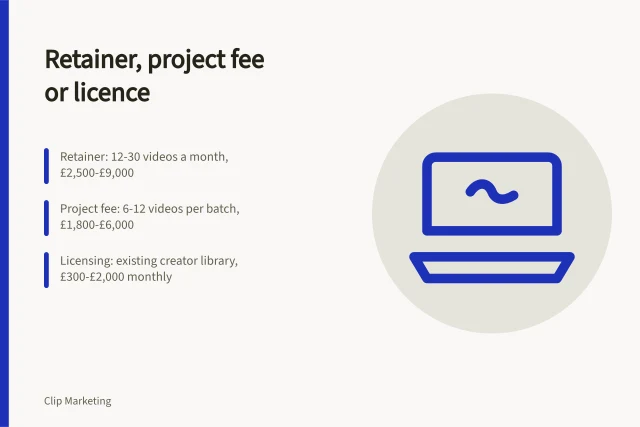
Illustrative worked example, not a market rate: 12 vertical edits a month. A freelance editor at £300 a day for three days is £900. An agency quoting £2,200 a month for the same 12 edits adds scripting, scheduling and cover. The £1,300 gap buys coordination you would otherwise handle yourself.
VAT is added by any supplier whose taxable turnover passes £90,000, a threshold unchanged since 1 April 2024 (GOV.UK). If your business is VAT registered you normally reclaim it, so compare net figures.
Retainer contents are not standard, so check what a month buys. Our guide to short-form video packages for local businesses sets out the usual tiers.
IR35 and how you engage the supplier
Off-payroll working rules decide whether a contractor working through their own company is taxed like an employee. Public sector bodies and medium or large private clients make that call. Small businesses are exempt, so the contractor's company decides.
Small company status follows Companies Act thresholds, so the exemption turns on the client's size. Ask for the supplier's status note before the first invoice.
A four-step way to choose
- Write down the finished videos you need each month, not the hours.
- Check the supplier is reala limited company appears at Companies House, and active filings should match the person you are dealing with.
- Send the same brief to a freelancer and to an agency, then compare the net total.
- Buy a paid test brief, one shoot and three edits, before you commit to a retainer.
Before filming, agree who owns the footage and how people appear on camera. Footage of identifiable staff or customers is personal data, so the supplier must follow your UK GDPR handling rules (ICO).
Also agree who signs off the final cut. Paid posts and branded content must meet the CAP Code, which covers misleading claims and paid partnership disclosure (ASA).
Common questions
Can we start with a freelancer and hire an agency later?
Yes, and many brands do. Keep the brief, shot list and raw footage, because they transfer to any supplier. Avoid contracts that lock footage to one editor's hard drive.
Do we need an agency if we already own a camera?
Only if nobody has time to plan and cut. A camera does not remove scripting, lighting, sound, captions or scheduling. A freelancer can cover production while your team keeps the strategy.
How do we check a freelancer's credentials?
Ask for two client references in your sector and watch the raw files, not just the published reels. Confirm the trading name, and for a limited company check its filings are current.
Who owns the footage if we leave?
Agree this in the contract before the shoot. The safest position is that your business owns the raw files on payment and the finished edits. The supplier keeps portfolio rights only with written permission.