Foundations
When to build short form video foundations for the England market
Short form video foundations for England: what changed, the data that matters, who is accountable under UK rules, and a before and after plan for 2027.
What to take away
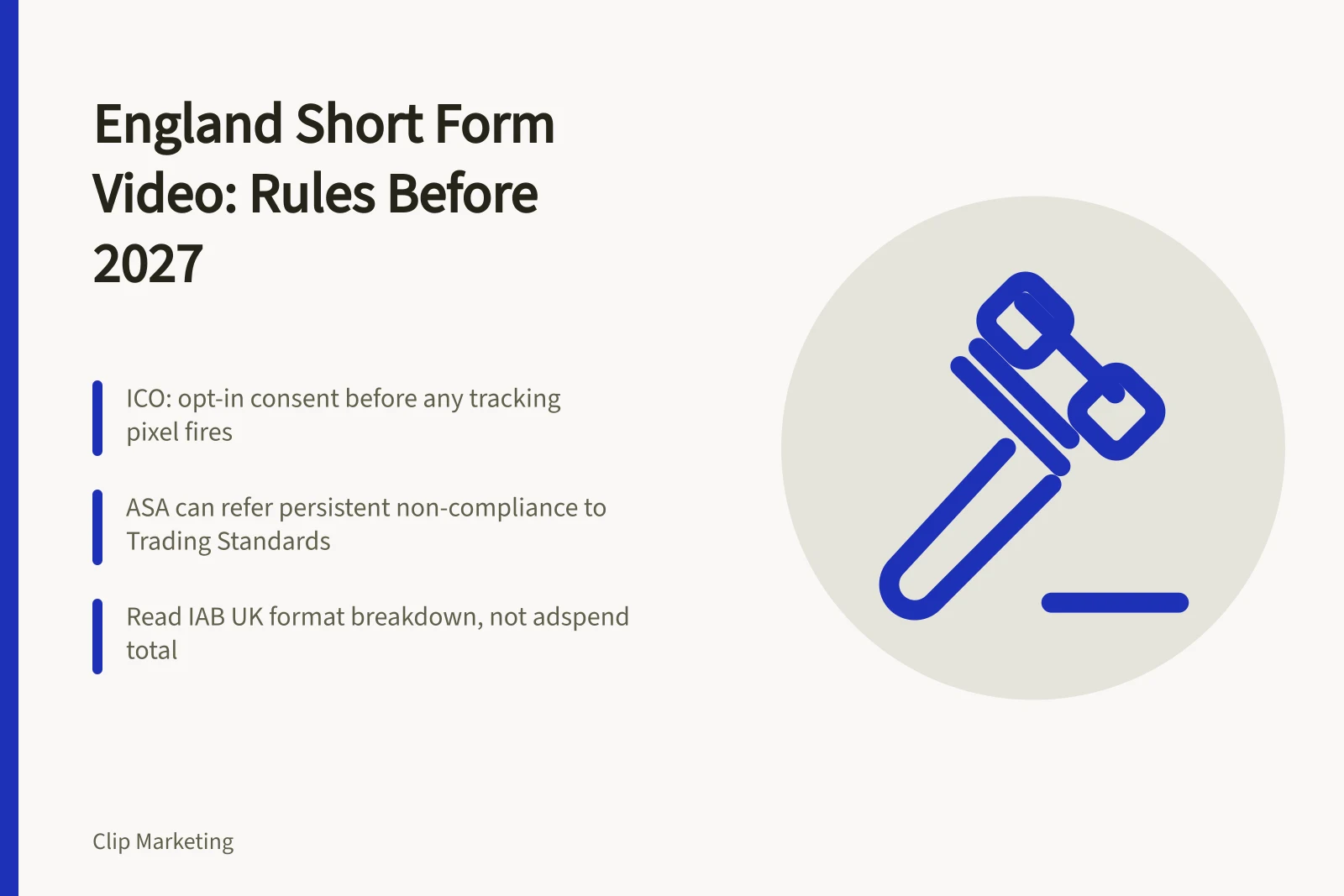
- Two UK-wide rule changes now bite hardest on short form video. The ICO's storage and access technologies guidance requires opt-in consent before any tracking script or pixel fires, and the ASA can refer persistent non-compliance to Trading Standards when warnings are ignored.
- Demand data sits on public pages, not in trade rumour. IAB UK publishes UK digital adspend by format, and the ONS digital economy pages give the business population those ads sell to.
- Platform payouts change the shape of the work. YouTube's own ad product pages set out how short video ads are bought and measured, so your format choices should follow the platform's rules rather than the other way round.
- The practical question for the next twelve months is not whether to run vertical video, but who owns consent, first-party data and the reporting line that survives an audit.
- Treat 2027 as a planning horizon. Build the consent layer and measurement spine first, then scale spend once your own numbers, not a vendor deck, justify it.
When did short form video become a board-level question in England?
It happened quietly. Vertical video stopped being a channel test and became a line in the media plan that finance teams ask about. That shift is why this guide leads with rules and numbers rather than creative tips.
Which regulator handles a complaint
Is it a one-off ad complaint?
ASA handles it
Trading Standards can prosecute
England has no separate advertising statute for video. The relevant duties sit in UK-wide law and UK-wide regulators, so an England-based team's practical difference is which enforcement route applies when something goes wrong.
The ASA handles most complaints, while Trading Standards can take on persistent offenders through the courts. That distinction matters because it changes who you call when a campaign goes sideways.
Budget conversations follow the same pattern. A marketing lead in Manchester, Leeds or London is now asked to justify vertical video against search and email, usually with a spreadsheet that mixes platform-reported views with site revenue. Those two numbers are not comparable, and boards are starting to notice.
Winning teams are not the loudest on camera. They have a consent record, a clean attribution story and a schedule that survives a quiet month.
For the data behind that shift, read short form video demand signals in England, which shows search and platform numbers where interest is building.
Is the England short form video market still growing?
UK digital adspend has grown across recent reporting periods, and video formats take a larger share of that money. IAB UK publishes headline figures in its UK adspend data.
That data is the reference most agencies quote when pitching a video-first plan, so read the format breakdown, not the total, because the total hides where the money moves.
For scope, this guide treats short form video as vertical-first footage made for feed placement, usually under three minutes and often watched with sound off. That definition has commercial consequences. It sets the production budget, the length of the hook and the reporting window, and it separates a repeatable channel from one-off brand films.
Client-side demand is broader than the consumer brands that dominate conference stages. The ONS digital economy statistics cover IT activity and e-commerce across the business population, which is the pool your services are sold into. A supplier with a five-person marketing team and a modest monthly retainer is a real buyer, not a rounding error.
Demand also comes from two directions. Brands building an in-house channel need training, templates and a review process that holds quality steady as staff change. Agencies and freelancers need positioning, proof and a reporting pack a finance director will accept, and the short form video commercial opportunities guide sets out which niches and budgets that work tends to sit in.
What has changed is the cost of entry. A phone, a ring light and a scheduling tool will get a credible channel live. What has not changed is the cost of doing it properly: consent tooling, analytics, someone to answer comments, and a named person accountable to the regulator if a complaint lands.
For planning purposes, assume the market is competitive but not saturated in England. Regional and B2B niches remain thinly served, and a specialist agency can build a defensible position without outspending a network.
Who is accountable under UK rules for vertical video ads?
Accountability is where most teams slip. The brand owns the claim, the agency owns the execution, and the platform owns its own ad policies. No one else absorbs the risk for you.
Who owns which risk
Brand
- Claim
- Owns
- Risk
- Carries
- Consent
- Owns
Agency
- Claim
- Executes
- Risk
- Carries
- Consent
- Implements
Platform
- Claim
- Ad policy
- Risk
- Own policy
- Consent
- Enforces
Which arrangement you choose decides who carries that risk day to day. The short form video business models in England guide compares the common options.
The ICO's guidance on storage and access technologies is the document to read before you place a single tracking pixel on a landing page or embed.
It explains when consent is needed for cookies and similar technologies, including pixels used to measure video campaigns. In practice that means a consent banner which blocks scripts until the user agrees, plus a record of what was consented to.
The ASA's Trading Standards referrals process is the other end of the scale. It covers what happens when a business keeps breaching the advertising codes after warnings. Sanctions can escalate beyond a name-and-shame ruling. For a small brand running paid vertical video, that is a reputational and commercial risk worth designing out early.
On the platform side, YouTube's ad formats documentation explains how short video ads are bought and served. Platform policy is not law, but a rejected ad or a suspended account stops revenue faster than any regulator. Read both.
What does a compliant short form video stack look like?
Start with consent. The consent tool must sit above every measurement script, not beside it. If your tag manager can fire a pixel before the banner loads, you have a problem, regardless of what the banner says.
Compliant short form video stack
- Consent tool above every measurement script
- Separate platform and business metrics
- One primary metric per campaign
- Build first-party data from day one
- Keep a dated approval log
- Name one compliance owner
- Review the stack every quarter
Next, separate platform metrics from business metrics. Views, watch time and completion rate are platform numbers. Leads, bookings and revenue are yours. Report them side by side and never blend them into one chart.
Reporting deserves its own rule. Pick one primary metric per campaign, agree it with the client before launch, and publish it on a fixed date. Reporting against whichever number looks best that month erodes trust faster than a poor week of performance.
Build first-party data as well. Email lists, booking records and on-site behaviour you collect directly do not depend on third-party cookies, so they keep working when consent is refused. Start the list on day one, with a stated reason for each sign-up.
Document decisions. Keep a short log of which claims were approved, by whom, and on what evidence. When a complaint arrives, a dated log is the difference between a quick resolution and a long argument.
Give one person the compliance brief. Shared accountability across a marketing team usually means no accountability. A named owner with a monthly check is enough for most small operations.
Finally, review the stack every quarter. Platform rules, consent expectations and reporting definitions change faster than annual planning cycles. A quarterly review takes an afternoon and prevents most nasty surprises.
What does the before and after picture look like?
The table below contrasts a typical 2025 setup with a 2027-ready one. The figures are illustrative examples, not benchmarks.
2025 setup vs 2027-ready setup
Typical setup before
- Consent
- Banner after launch
- Measurement
- Platform views as performance
- Ownership
- No named owner
- Content mix
- One-off campaigns
- Spend
- Ad hoc, no review
- Records
- Screenshots in folder
2027-ready setup
- Consent
- Blocks scripts until opt-in
- Measurement
- Platform and revenue separate
- Ownership
- One named owner
- Content mix
- Rolling reusable schedule
- Spend
- Fixed budget, cost per lead
- Records
- Dated approval log
Notice that none of the changes require a bigger team. They require a decision about who does what, made once and reviewed regularly. Teams that make that decision early tend to spend less on rework and more on content that performs.
What should be in place before you commit budget?
Four things before committing budget
- Consent layer that works
- Measurement plan separating platform and business numbers
- Named owner for compliance
- Content schedule sustainable for six months
Then check the boring details. Does your landing page load quickly on a mid-range Android phone? Can a viewer understand the offer without sound? Is the call to action visible in the first two seconds of a vertical video? These are the factors that decide whether paid reach converts.
If you are entering the market as a supplier rather than a brand, work through the short form video market entry checklist in England. It covers the operational steps in sequence, from registration and insurance through to your first client reporting pack.
Budget for compliance as a line item, not an afterthought. A consent tool, a small legal review and a quarterly audit are modest costs against the price of an upheld complaint or a suspended ad account. For a team spending £2,000 a month on media, a few hundred pounds a quarter on compliance is proportionate.
How should you plan for 2027?
Treat 2027 as the year the market settles into clearer expectations. Consent enforcement, platform policy and client reporting standards are all moving in the same direction: more evidence, less assertion.
Build the foundations now and the creative work gets easier. Build them late and every campaign carries avoidable risk. The short form video trends and outlook for England in 2027 piece sets out the wider direction of travel, including format shifts and what England-based buyers are likely to ask for.
Four-quarter planning sequence
- Quarter 1Fix consent and measurement
- Quarter 2Document ownership and claims
- Quarter 3Run paid pilot on fixed budget
- Quarter 4Review unit economics before scaling
Set the review cadence before the first invoice. A monthly look at cost per lead, a quarterly look at consent logs and a yearly look at contracts is enough for most England-based teams. Anything more frequent becomes noise, and anything less lets problems surface late.
England, Scotland, Wales and Northern Ireland share the advertising codes and the ICO's remit. A campaign built for England will generally be compliant across the UK.
Where rules differ, it is usually in local licensing or sector-specific regulation, not in the core advertising framework. Check those sector rules if you work in finance, health or gambling.
Common questions
Do I need consent for pixels used in short form video campaigns?
Yes, in most cases. The ICO's storage and access technologies guidance treats advertising pixels as technologies that store or access information on a user's device, so consent is normally required before they fire. Place the consent tool above your tag manager and log what each user agreed to.
Does the ASA fine businesses for bad video ads?
The ASA itself does not issue fines. It can refer persistently non-compliant advertisers to Trading Standards, which can pursue the matter through the courts. For most brands the reputational cost of a published ruling is the bigger deterrent, so fix the claim before you publish.
Is short form video still worth the budget in England?
The format continues to attract a growing share of UK digital adspend, and the client base is broad. The deciding factor is whether you can measure it against business outcomes. If you can separate platform views from site revenue, the budget case is straightforward.
What is the single most common mistake in vertical video marketing?
Treating platform-reported views as business results. Views measure distribution, not demand. Teams that pair platform metrics with their own conversion data make better budget decisions and spot failing campaigns earlier.
In this guide
- Before you quote a short form video market size in England, define what countsBefore you quote a short form video market size in England, check what the figure counts, where it comes from and how to score your own estimate.
- How to read short form video demand signals from search and adsA practical listicle on reading short form video demand signals, covering search interest, ad tools, buyer behaviour and the legal limits on audience data.
- Compare short form video business models before you commitCompare the main short form video business models used by England-based teams, from retainers to licensing, with the cost, control and risk each one carries.
- What the short form video market entry checklist means for English brandsA compliance-first short form video market entry checklist for England, covering data rules, platform terms, creative review and the decision points before launch.
- Short form video commercial opportunities without the guessworkA practical England guide to short form video commercial opportunities, covering paid ads, affiliate income, licensing fees and the consent rules behind each route.