Audience research
Part of Audience data or audience guesswork, the short form video audience research guide
How to build a short form video target audience profile
Learn how to build a short form video target audience profile using first-party data, IAB UK standards and ASA guidance before you brief a single edit.
What to take away
A short form video target audience is the specific group of people you want your vertical clips to reach, described in evidence rather than assumption.
- Write a one-line audience definition before you brief any creative.
- Build it from first-party data and real conversations, not platform guesswork.
- Check every data source against current UK marketing data rules.
- Keep a before-and-after record so the profile can be audited later.
Define the audience in one line
Start with a sentence you can defend, such as: we make 20-second vertical clips for 25 to 34 year old renters in Greater Manchester comparing deposit schemes.
One-line audience definition
- Format20-second vertical clips
- Age25 to 34 year old renters
- LocationGreater Manchester
- Topiccomparing deposit schemes
- Write in present tense
- Add a date to the version
That sentence does more work than a persona slide. It names a format, a length, a life stage and a place. It also sets a boundary, which matters when someone suggests widening the net.
Write it in the present tense and put a date on it, so a later reader can tell which version they are looking at.
The audience research guide for England shows how this definition fits into a wider research plan, so read it before writing yours.
Gather first-party signals first
Your own records beat borrowed insight. Support tickets, site search terms and sales call notes all describe people who already found you.
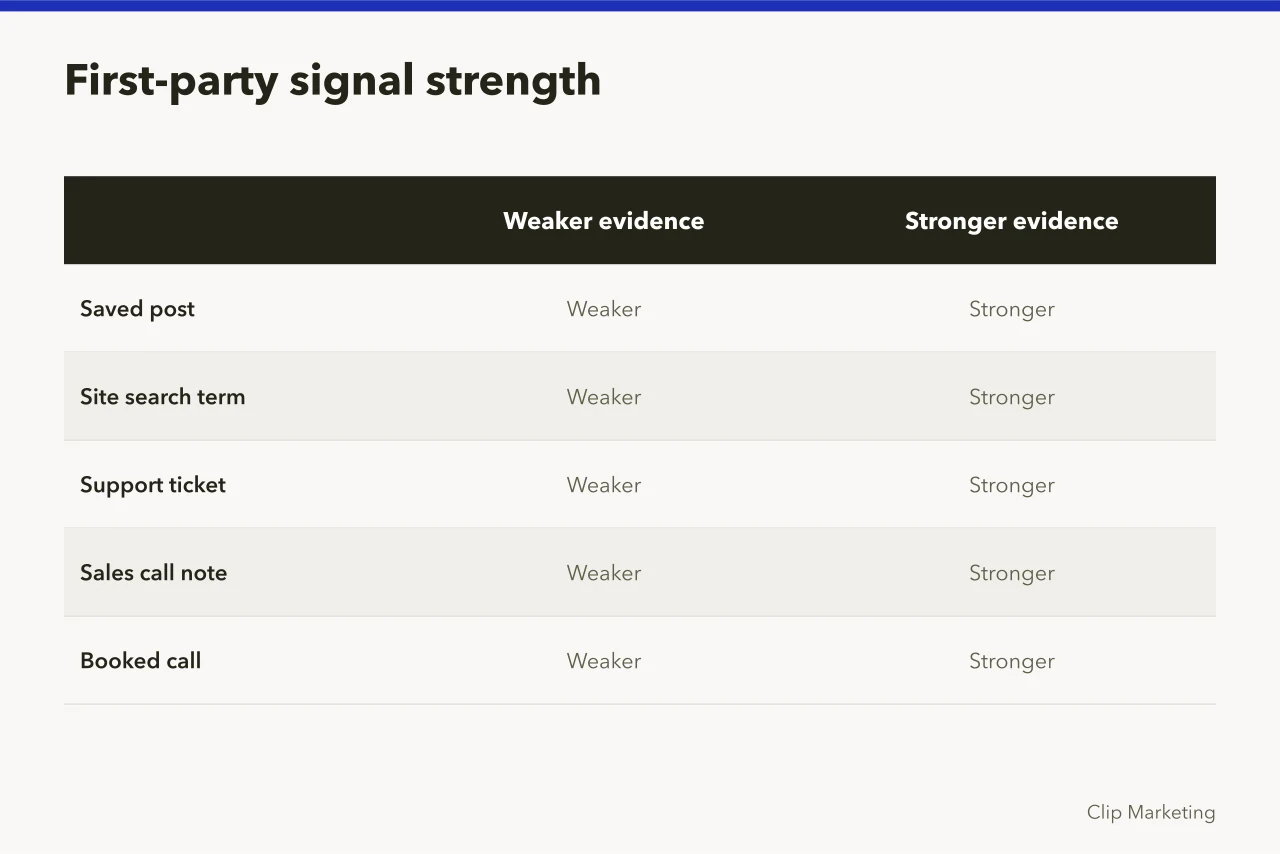
Sort those signals by how close they sit to a purchase decision. A saved post is weaker evidence than a booked call.
Group them by life stage rather than by product. A renter nearing the end of a tenancy behaves differently from an owner remortgaging, even when both read the same page.
If you hold email lists or customer records, treat them as personal data. The ICO summary of the Data (Use and Access) Act 2025 sets out the current legal framework. Marketing use of that data sits inside it.
Write down where each signal came from. A profile built on six months of enquiry notes is stronger than one built on a hunch.
Use platform data with care
Platform dashboards describe people who already saw your clips. That is useful, but it is a biased sample.
Compare each clip against your own rolling average rather than your best performer. One viral clip is an outlier, not a benchmark.
Industry bodies publish format and measurement conventions that keep comparisons honest. The IAB UK standards and guidelines library covers digital advertising including video, which helps when you compare performance across placements.
Note what a dashboard cannot tell you. It rarely explains why someone stopped watching, or what they did next.
Before and after profile
A profile improves when you replace assumptions with named sources. The table below shows an illustrative shift.
Typical draft
- Age band
- 18 to 24, because the platform skews young
- Location
- National
- Trigger
- Wants to save money
- Format
- Vertical video, no length given
- Evidence
- None recorded
Evidence-led version
- Age band
- 25 to 34 renters who enquired in the last 90 days
- Location
- Greater Manchester, Leeds, Bristol
- Trigger
- Comparing deposit protection schemes before a tenancy ends
- Format
- 20-second vertical video, sound on, captions burned in
- Evidence
- Enquiry notes and interviews, all dated
Notice how each row moves from a guess to a source. That is the whole method in miniature.
Date the table and keep the previous version. Six months later, the older column shows exactly which assumptions you replaced.
Check the rules before you publish
Advertising rules apply to short-form video as much as to television. Claims, disclosures and targeting all fall inside the CAP Code.
The CAP Code also expects marketing communications to be obviously identifiable as advertising, so a paid clip needs a clear label.
The ASA resource library collects guidance on the advertising rules that apply to social and short-form content. Read it before you sign off a script.
Keep a dated note of which rules you checked. That record helps if a complaint arrives later.
Interview a small sample
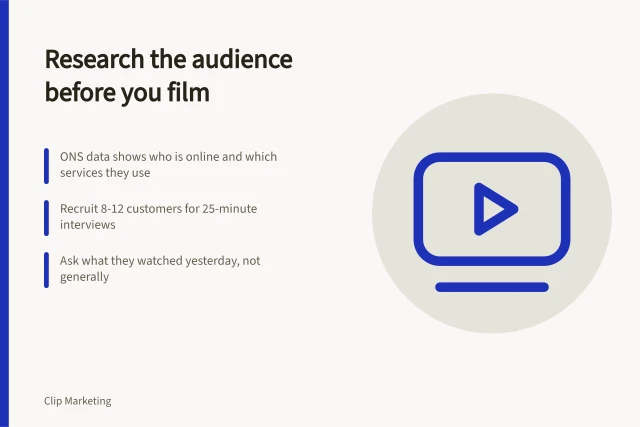
Eight to twelve conversations usually beat a large survey at this stage. Ask what people were doing when they last watched a clip like yours.
Ask permission before recording, and store the notes without names where you can.
The customer interview method explains how to run those sessions in England. It covers how to avoid leading questions, the usual reason interviews produce flattering nonsense.
Record the exact phrases people use. Those phrases become hooks, captions and titles.
Common questions
How many people should I speak to?
Start with eight and stop once new conversations repeat what you already know. For example, a team speaking to ten customers often hears the same three objections.
Do I need a persona document?
No. A one-line definition with a source list does more, because personas tend to drift into invented detail.
How often should the profile change?
Review it each quarter, or sooner if your product or platform mix shifts. Date every version so you can trace what changed.
Can I rely on platform audience tools?
No. They describe people who already watched, not the ones you have yet to reach. Pair them with first-party signals.