

Audience research
Part of Short form video audience research: a practical UK guide
What short form video customer interviews mean for audience research
A practical listicle on running short form video customer interviews in England, covering consent, question design, recruitment and the records you keep.
What to take away
- Customer interviews for short form video are the fastest way to find the words real buyers use, and those words belong in your hooks and captions.
- The ICO's Age Appropriate Design Code raises the bar on consent when your audience includes under-18s.
- The CAP advertising codes still govern what you can promise in a social ad, whatever the interview reveals.
- Six to ten interviews usually expose the main themes; more only confirms them.
- Store recordings, notes and consent in one place so a future audit takes minutes, not days.
Short form video customer interviews are structured talks with people who already buy from you. You run them so their answers can be reused as creative — real lines for hooks and captions on TikTok, Instagram Reels or YouTube Shorts.
What changed is the paperwork. Anything you film or write up now sits under the UK GDPR and the Data Protection Act 2018, and consent duties for younger audiences have tightened under the ICO's Age Appropriate Design Code. The ASA still polices claims in paid social. An interview filmed casually in 2022 is harder to defend now.
Set the rules before you record
Who counts as a customer for this exercise
Decide the inclusion criteria first. A workable definition: bought or enquired in the last twelve months, watches vertical video, lives in the market you serve.
If you sell across the UK, say so. If your trading address and delivery area are in England, keep the sample in England so the language matches your ads. Exclude staff, agencies and anyone paid in goods, because their answers flatter you.
Geography matters more than most teams admit. A phrase that lands in Manchester may read as odd in Glasgow or Cardiff. If you plan to advertise UK-wide, recruit across the nations. If you only ship within England, a purely English sample is honest and simpler to explain later.
Consent, age and the records you keep
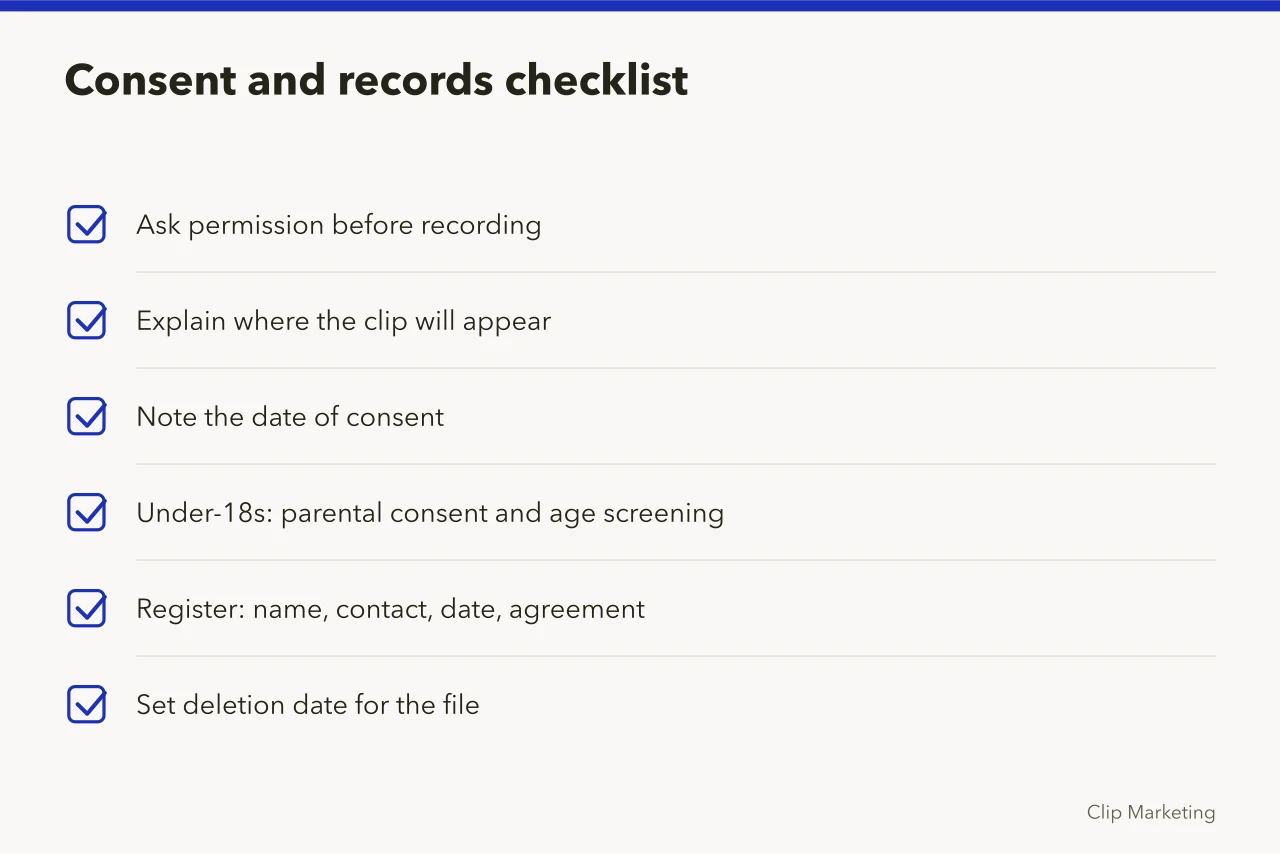
Ask permission before recording, explain where the clip will appear, and note the date. The ICO's Age Appropriate Design Code sets out how age-appropriate design and consent apply to younger people, so treat under-18 participants as a separate category with parental consent.
The UK GDPR gives you a choice of lawful bases — consent, legitimate interests or contract — and you should pick one and write down which you are relying on before you press record. Our audience research guide for short form video covers choosing between them in more depth.
Keep a simple register: name, contact, date, what they agreed to, and when you will delete the file. If you later quote them in a paid ad, the CAP advertising codes still apply to the claim itself. The ASA publishes the UK advertising codes that govern non-broadcast and direct marketing, including social ads.
Run the interview so the answers are usable
Question order that produces quotable lines
Start broad, then narrow. Ask what they were trying to solve the week they bought. Ask what they typed into search or social before they found you. Ask which accounts they follow on TikTok, Instagram Reels or YouTube Shorts and why they stopped scrolling. Only then show a draft hook and ask what they expected to happen next.
Question order for usable quotes
- Ask what they were trying to solve
- Ask what they typed into search or social
- Ask which accounts they follow and why
- Show a draft hook, ask what happens next
- Write three strongest quotes same day
Avoid leading questions. "Would you watch this?" invites politeness. "What did you think this video was selling?" invites an answer you can use. Record the session if they agree, and write the strongest three quotes into your notes the same day, while the tone is still fresh in your memory.
Recruitment from your own list
Your existing list is the cheapest source. Send a short message to recent buyers, offer a modest thank-you, and book twenty-minute slots. Ten conversations at twenty minutes each is under four hours of calls, plus write-up.
If you need people outside your list, use a panel or a community group, but check the answers against your own buyers. For a wider view of who you are trying to reach, our target audience notes for England explain how to segment before you recruit.
Decide, then document
Choosing a method for your situation
Choosing a method
Choose
- Under 500 customers, England only
- Six to ten one-to-one calls
- Mixed UK audience
- Calls spread across nations
- Audience includes under-18s
- Parental consent and age screening
- Regulated product
- Scripted questions and legal review
- Tight budget
- Existing customer list
Avoid
- Under 500 customers, England only
- Large surveys with no follow-up
- Mixed UK audience
- England-only sample
- Audience includes under-18s
- Open DMs to minors
- Regulated product
- Improvised claims on camera
- Tight budget
- Paid panels as a first step
Turning answers into scripts and captions
Take the exact phrases and use them as hooks. If three people said they were "tired of guessing sizes", that phrase belongs in the first two seconds of a vertical video, not a paraphrase. Keep a running document of quotes with the date and the participant's initials.
Where you cite a statute in your internal policy — the Data Protection Act 2018, for instance — link to its official text on legislation.gov.uk so the reference does not rot and you can check the current wording yourself.
Common questions
How many customer interviews do I need?
Six to ten is usually enough to hear the same themes repeat. Stop when two consecutive calls add nothing new.
Can I use interview clips in paid ads?
Only with recorded consent covering paid use. The claim in the ad must still comply with the CAP codes.
Do I need parental consent for under-18s?
Yes. Treat younger participants as a separate group with age screening and parental permission, following the ICO's Age Appropriate Design Code.
Should I interview customers outside England?
Only if you advertise or sell there. Match the sample to the market your videos will actually reach.