Strategy
Part of What length should short-form videos be for UK brands?
What length should short-form videos be for UK brands?
Practical durations for short-form video by UK feed, goal and audience, with clear advice on testing the length for vertical video campaigns.
What to take away
- The best length depends on the joba cold-audience hook, a product demo and a retargeting ad need different runtimes.
- For most UK vertical video feeds, 15 to 30 seconds is a safe starting point for awareness and direct response.
- Longer videos can work when the viewer has intent, such as a product demonstration or a detailed explainer.
- Test two or three durations per concept, then keep the version that holds attention through the first three seconds and the call to action.
- Shorter is not automatically better. A rushed 6-second ad can confuse; a padded 60-second ad can lose the room.
Why one length does not fit every feed
Short-form video is usually defined by format and feed rather than a fixed runtime, as the short-form video Wikipedia entry explains. A 15-second clip on TikTok, a 30-second Reel and a 45-second YouTube Short all sit inside the same broad category, but they do different work.
UK viewers scroll in vertical video feeds, so orientation matters. Vertical video keeps the subject centred on a phone screen and removes the need for letterboxing.
The first seconds carry most of the weight. If the opening frame does not signal the topic, the viewer leaves before the message lands. Length only helps when the hook earns the next second.
A duration framework for UK vertical video
A duration framework
Suggested length
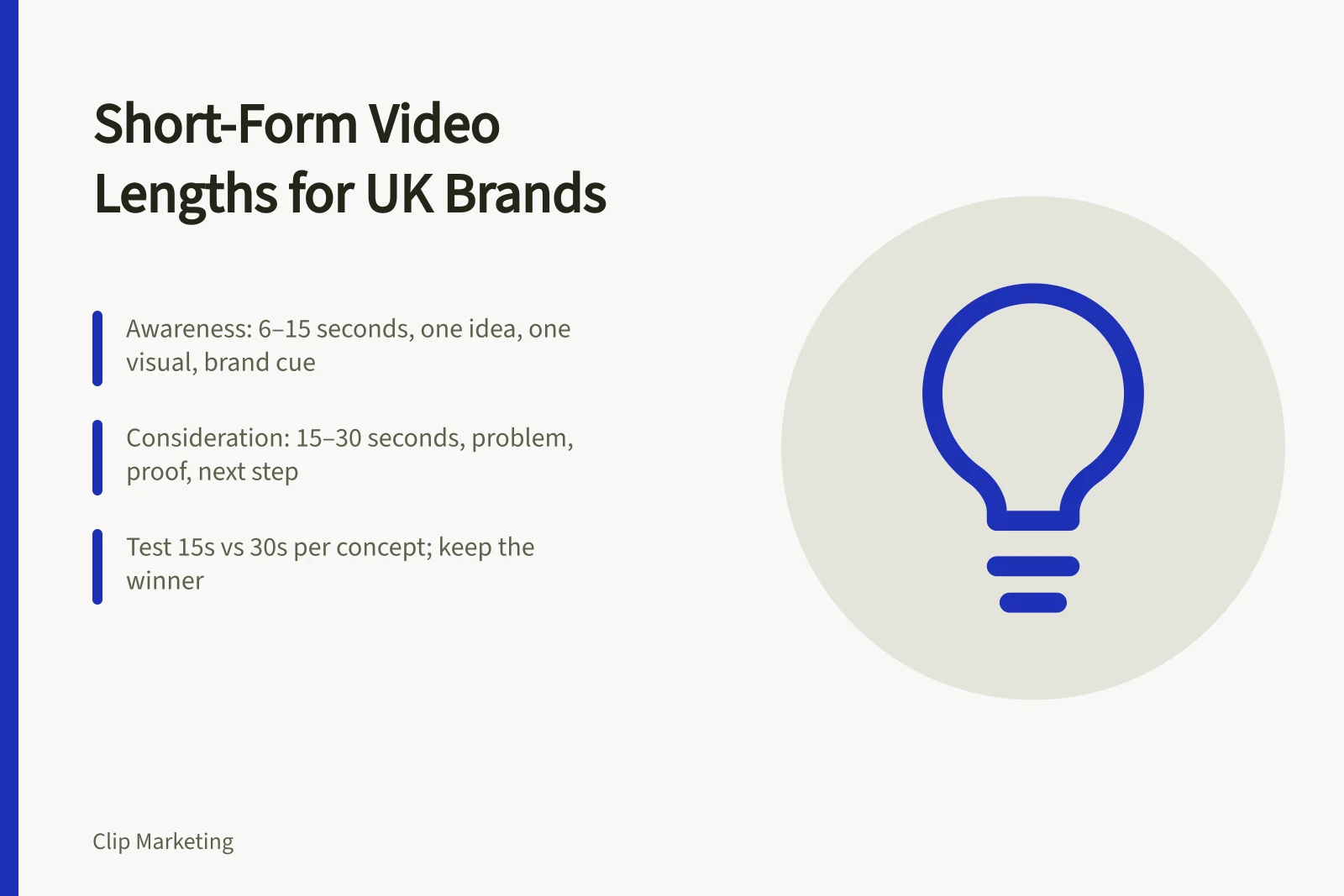
- Awareness
- 6 to 15 seconds
- Consideration
- 15 to 30 seconds
- Product demo
- 30 to 60 seconds
- Testimonial
- 30 to 45 seconds
- Retargeting
- 10 to 20 seconds
- Detailed explainer
- 60 to 90 seconds
What to include
- Awareness
- One idea, one visual, brand cue
- Consideration
- Problem, proof, next step
- Product demo
- Setup, demonstration, result
- Testimonial
- Customer, outcome, invitation
- Retargeting
- Reminder, offer, deadline
- Detailed explainer
- Context, steps, summary
Use these ranges as starting points, not rules. A local service business may need 20 seconds to explain a booking process, while a fashion brand can show a garment in 8 seconds. The right length is the shortest time that completes the job without rushing the viewer.
Video length by marketing goal
Goal
- Awareness
- 6 to 15 seconds
- Consideration
- 15 to 30 seconds
- Product demo
- 30 to 60 seconds
- Testimonial
- 30 to 45 seconds
- Retargeting
- 10 to 20 seconds
- Detailed explainer
- 60 to 90 seconds
Suggested length
- Awareness
- One idea, one visual, brand cue
- Consideration
- Problem, proof, next step
- Product demo
- Setup, demonstration, result
- Testimonial
- Customer, outcome, invitation
- Retargeting
- Reminder, offer, deadline
- Detailed explainer
- Context, steps, summary
What to include
- Awareness
- Consideration
- Product demo
- Testimonial
- Retargeting
- Detailed explainer
If you are planning the opening, a structured approach helps. Learn how to write short-form video scripts for UK brands so the length serves the story rather than the other way around.
The ranges above are not platform mandates. They are working durations that fit common UK marketing goals. A 6-second bumper can work for brand recall, while a 90-second explainer can work for a considered purchase. The test is whether the viewer reaches the end with the message intact.
How to test and adjust lengths
How to test and adjust
- Pick one concept and one audience.
- Cut a 15-second version with the hook in the first two seconds.
- Cut a 30-second version that adds context and proof.
- Publish both at similar times and compare watch time, completion rate and click-through.
- Keep the winner, then test a 45-second version only if the topic needs more detail.
Do not test every length at once. Two versions per concept is enough to learn whether the extra seconds add value or dilute the message.
How to test video lengths
- Pick one concept and one audience
- Cut a 15-second version with early hook
- Cut a 30-second version adding context
- Publish both and compare watch time
- Keep winner, test 45 seconds if needed
Platform differences that affect length
TikTok rewards fast pacing and native-looking edits. Instagram Reels often supports slightly longer lifestyle or brand stories. YouTube Shorts can carry a more explanatory tone because viewers expect to stay for a payoff.
For a closer comparison, see Instagram Reels vs TikTok before you commit your budget to one feed.
Paid promotion adds another constraint. If a video is an ad, the CAP Code requires it to be recognisable as advertising. That can affect length because you need clear disclosure without killing the hook. A short sponsor line at the start or a persistent label can satisfy the rule.
Keep sound off in mind. Many UK viewers watch with sound off in public or at work, so captions and on-screen text carry the message. That makes tight editing more important than raw duration.
Common questions
How long should a TikTok video be for a UK business?
Start with 15 to 30 seconds for most cold-audience content. If the video needs a demonstration or a detailed explanation, 45 to 60 seconds can work when the hook is strong.
Is 15 seconds always better than 60 seconds?
No. A 15-second video can feel rushed if it has to explain a service, price or process. A 60-second video can work if every second earns attention. Match length to the message.
What is the best length for Instagram Reels in the UK?
For reach, 15 to 30 seconds is a practical starting point. For saved or shared content, such as a tutorial, 30 to 60 seconds often gives enough room to be useful.
Do captions change the ideal length?
Yes. Captions let viewers follow without sound, but they also add reading time. If the text is dense, give the viewer a few extra seconds instead of speeding through the words.