Reviews
Part of Why short form video reviews need a method you can audit
Short form video product comparison: buy or build for your team?
Compare CapCut, Premiere Pro, Descript, Opus Clip and Buffer on rights, captions and price, then decide whether to buy or build for your team.
What to take away
- Compare named productsCapCut, Adobe Premiere Pro, Descript, Opus Clip and Buffer. Each solves a different part of short form video.
- Score export rights, caption accuracy, scheduling, data terms and price. A demo hides these until after purchase.
- Use dated evidence and the short form video review method to keep scoring repeatable.
- Check placement claims against the IAB UK ad portfolio standard and enforcement risk via ASA sanctions.
- Buy for narrow caption or scheduling needs. Build when rights clearance, archive access or API control is unusual.
Which short form video products should you compare?
CapCut is a mobile and desktop editor with vertical templates, auto captions and export presets. It has a free tier, and a Pro subscription adds cloud storage and premium assets. It suits small teams that need fast edits.
Short Form Video Tools
CapCut
- Type
- Mobile/desktop editor
- Captions
- Auto
- Price
- Free/Pro
- Best for
- Fast edits
Premiere Pro
- Type
- Timeline editor
- Captions
- Speech-to-text
- Price
- Subscription
- Best for
- Frame control
Descript
- Type
- Text-based editor
- Captions
- Transcription
- Price
- Free/subscription
- Best for
- Dialogue clips
Opus Clip
- Type
- Clip generator
- Captions
- Auto
- Price
- Monthly
- Best for
- Long recordings
Adobe Premiere Pro is a professional timeline editor with speech-to-text captions and detailed export controls. It is subscription only. It suits teams with Adobe workflows and editors who need frame-level control.
Descript is a text-based editor that transcribes footage and lets you cut by deleting words. It offers a subscription with a free tier. It suits interview or podcast clips where dialogue drives the cut.
Opus Clip turns long recordings into short vertical clips with auto reframing and captions. It uses a subscription, often monthly. It suits teams with webinars, podcasts or YouTube archives.
Buffer provides social scheduling and analytics for Instagram, TikTok, YouTube Shorts and LinkedIn. It has a free plan for small users, while paid plans add users and features. It suits teams that edit elsewhere.
Canva is a browser design tool with video templates, captions and Content Planner scheduling. It has a free tier, and Pro adds a brand kit and storage. It suits non-editors making simple clips.
What changes the UK scoring?
The regulatory line is where comparisons often go quiet. The Advertising Standards Authority can name an advertiser and require amendments. Its published list of sanctions shows the reputational cost.
UK Scoring Checklist
- ASA sanctions list checked
- DMCC Act 2024 data handling
- IAB UK format claims sourced
- Agency evidence and contacts
- Retention periods explained
Data handling deserves its own score. The Digital Markets, Competition and Consumers Act 2024 is part of the context for consumer data and marketing. A vendor that cannot explain retention periods should lose points.
Format claims need a source. The IAB UK summary of the new online ad portfolio sets out how video formats sit alongside other online ad units.
If your shortlist includes agencies, score evidence of past work and named contacts. Our guide to short form video agency reviews in England covers how to test those claims before signing.
Should you buy a product or build in-house?
Buying wins when the need is narrow and repeatable. If you publish twelve vertical clips a month and captions are the bottleneck, a subscription tool solves it faster than hiring.
Building wins when the workflow is unusual. A publisher with archive footage and bespoke rights clearance may spend more time bending a product than writing its own process.
A build stack might use FFmpeg for encoding, DaVinci Resolve for editing, Mux for video APIs, Cloudinary for asset delivery and AWS Elemental MediaConvert for transcoding. These need developer or editor time.
A team paying £400 a month for editing, captions and scheduling spends £4,800 a year. That figure is illustrative. Compare it with the hours your team loses at your internal rate.
How should you score the table?
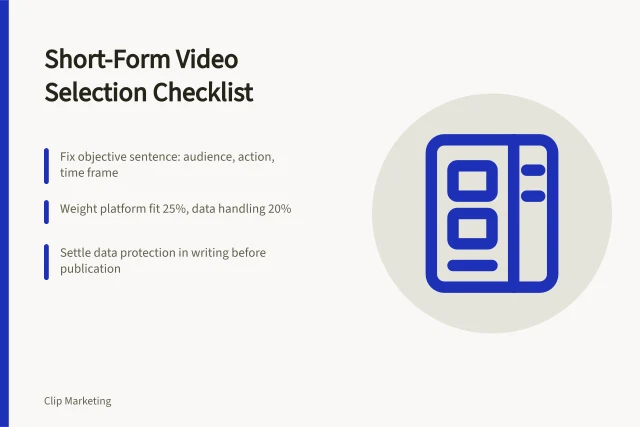
Weight criteria before you look at any product. If you weight after, you will favour whichever tool demoed best. A defensible split is output quality 25 per cent, publishing reliability 20 per cent and captions 15 per cent. Data terms, export rights and support take 15, 15 and 10 per cent.
Keep one row per product and one column per weighted criterion. Add a source column and a date column. A score without a date is worthless by the next quarter.
Record the evidence beside each score. 'Captions accurate' is not evidence. 'Caption accuracy checked against three sample clips on 3 September 2026' is.
Finish with a note on what would change the ranking. Price rises, export rights changes or a new sanctions ruling can move a product down.
Common questions
How many products should a comparison cover?
Three to five is workable. Fewer than three gives no real choice, and more than five makes the scoring shallow because nobody can evidence every line properly.
Do I need legal review before choosing a tool?
Not always, but someone must read the data processing terms. If the tool ingests customer footage or personal data, ask a qualified adviser rather than relying on the vendor's summary.
Can I reuse one comparison next year?
Reuse the structure, not the scores. Format standards, sanctions and pricing all move, so re-score each line against a fresh dated source before you renew.
What if two products score the same?
Break the tie on the criterion that is hardest to change later, usually export rights or data retention. Switching costs matter more than a marginal feature advantage.