Audience research
Part of Instagram Reels vs TikTok for UK business: where should you post?
Instagram Reels vs TikTok for UK business: where should you post?
Compare Instagram Reels and TikTok for UK business: audience differences, engagement patterns and where to post first, based on Ofcom and ONS data.
What to take away
- TikTok is a video-first app with a recommendation feed, so new accounts can reach strangers quickly.
- Instagram Reels sits inside a wider app used across more age groups, which suits service businesses with an existing following.
- Pick the platform that already holds your buyers, then post consistently for eight weeks before judging it.
- Measure watch time and saves rather than follower count.
The core difference between Reels and TikTok
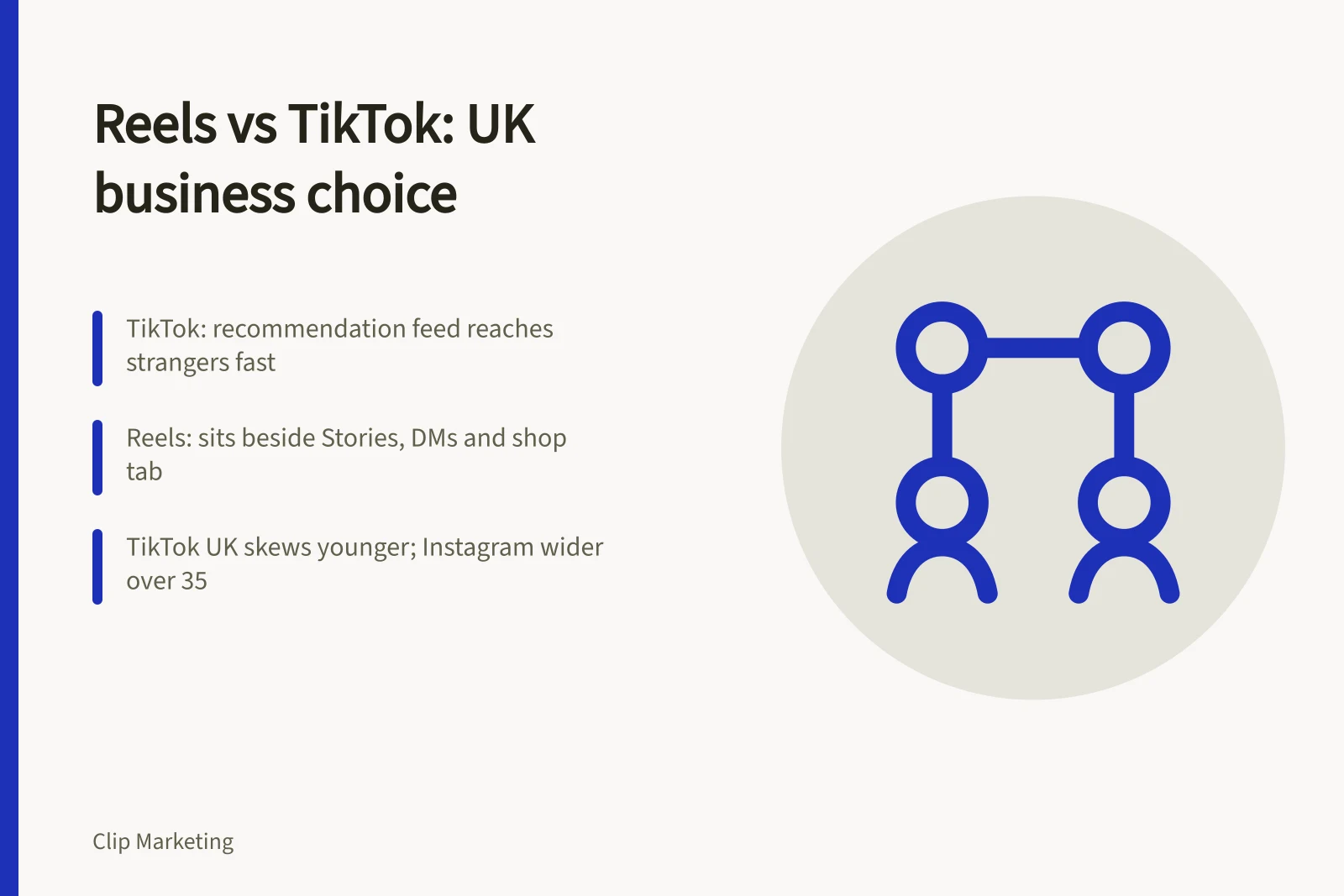
TikTok opens straight into a feed of recommended videos, so the clip does the work rather than the follower count. TikTok A new UK account with no audience can still reach thousands of viewers on one upload.
Reels is a format rather than a separate platform. Instagram Reels sits beside Stories, direct messages and the shop tab, so a viewer can move to a profile or a product page in a few taps.
UK audience patterns to weigh up
Ofcom's Online Nation research is the standard UK reference for platform reach by age band, and it is worth reading before you commit to a schedule. TikTok's UK base skews younger than Instagram's.
ONS digital economy data gives the wider context for how much UK business activity now runs online, which helps when you make the case for a video budget. It will not tell you which platform to choose, but it will show how much of your sector's customer contact now starts on a screen.
For firms selling to homeowners, practice managers or finance directors, Instagram holds more of the audience over 35. If that is your buyer, read why short-form video works for UK professional services before you write a script.
Comparing the platforms side by side
TikTok
- How people arrive
- Recommendation feed, mostly strangers
- Typical strength
- Discovery for products and local offers
- Content that travels
- Fast hooks, demonstrations, trends with a twist
- Age skew in the UK
- Younger adults
- Route to action
- In-app shop, profile link, comment replies
- Main cost
- Time, plus ad spend if you boost posts
- Weakest point
- Comments need moderating
Instagram Reels
- How people arrive
- A mix of followers, the Reels feed and shares
- Typical strength
- Trust building with an audience that already follows you
- Content that travels
- Behind the scenes, tips, customer proof
- Age skew in the UK
- Wider range, stronger over 35
- Route to action
- Link in bio, direct messages, tagged products
- Main cost
- Time, plus the expectations of existing followers
- Weakest point
- Reach can stall if the account is dormant
Where each platform fits your funnel
TikTok earns its place at the top of the funnel. A recommendation feed can put a small UK brand in front of buyers who have never heard of it, and the price of that reach is time rather than money.
Instagram Reels tends to work further down the funnel. A viewer who watches a Reel can tap a tagged product, send a direct message or follow a link in the bio without leaving the app.
A product sold across the whole UK can justify TikTok. A business serving one city, or selling to a professional buyer, often gets more from Reels.
Turning audience data into a choice
Whichever platform you choose, the production constraint is the same: you need vertical footage that holds attention without sound. TikTok rewards a hard hook in the first second, quick cuts and on-screen text. Reels tolerates a slower opening, and it can send viewers to a profile grid that still carries weight.
Turning audience data into a choice
- Write down the single action you want
- Check which platform existing customers use
- Choose the platform that holds your buyers
- Commit to one posting rhythm for eight weeks
- Add the second platform only when enquiries come
Film vertically from the first take rather than cropping a horizontal clip later; how to shoot vertical video on an iPhone sets out a phone setup that works for one-person teams.
What to measure in the first month
- Views that passed three seconds.
- Average watch time per view.
- Saves and shares, which signal intent.
- Profile visits and link taps.
- Comments that ask a buying question.
Follower count is the weakest signal on both platforms. Watch time and saves tell you whether a video did a job, and profile visits tell you whether it did the right one.
What to measure in month one
- Views that passed three seconds
- Average watch time per view
- Saves and shares, which signal intent
- Profile visits and link taps
- Comments that ask a buying question
Judge both apps on the same numbers: how many viewers stayed past three seconds, how many watched to the end, and how many tapped through to your site or profile.
Give a platform eight to twelve posts before you decide. One viral clip is not evidence, and a quiet fortnight is not failure. A single platform, posted to properly, beats two accounts updated in a panic on a Friday afternoon.
Common questions
Is TikTok or Instagram Reels better for a UK business?
There is no universal winner. TikTok makes cold reach easier, while Reels suits businesses whose buyers already sit inside Instagram.
Do I need separate videos for each platform?
Not at first. Shoot once, then adjust the opening two seconds and the caption tone for each app.
How long should I test one platform before adding the other?
Eight weeks of consistent posting is a fair trial. If saves and profile visits stay flat after that, change the format before you add a second platform.